
Book Appointment

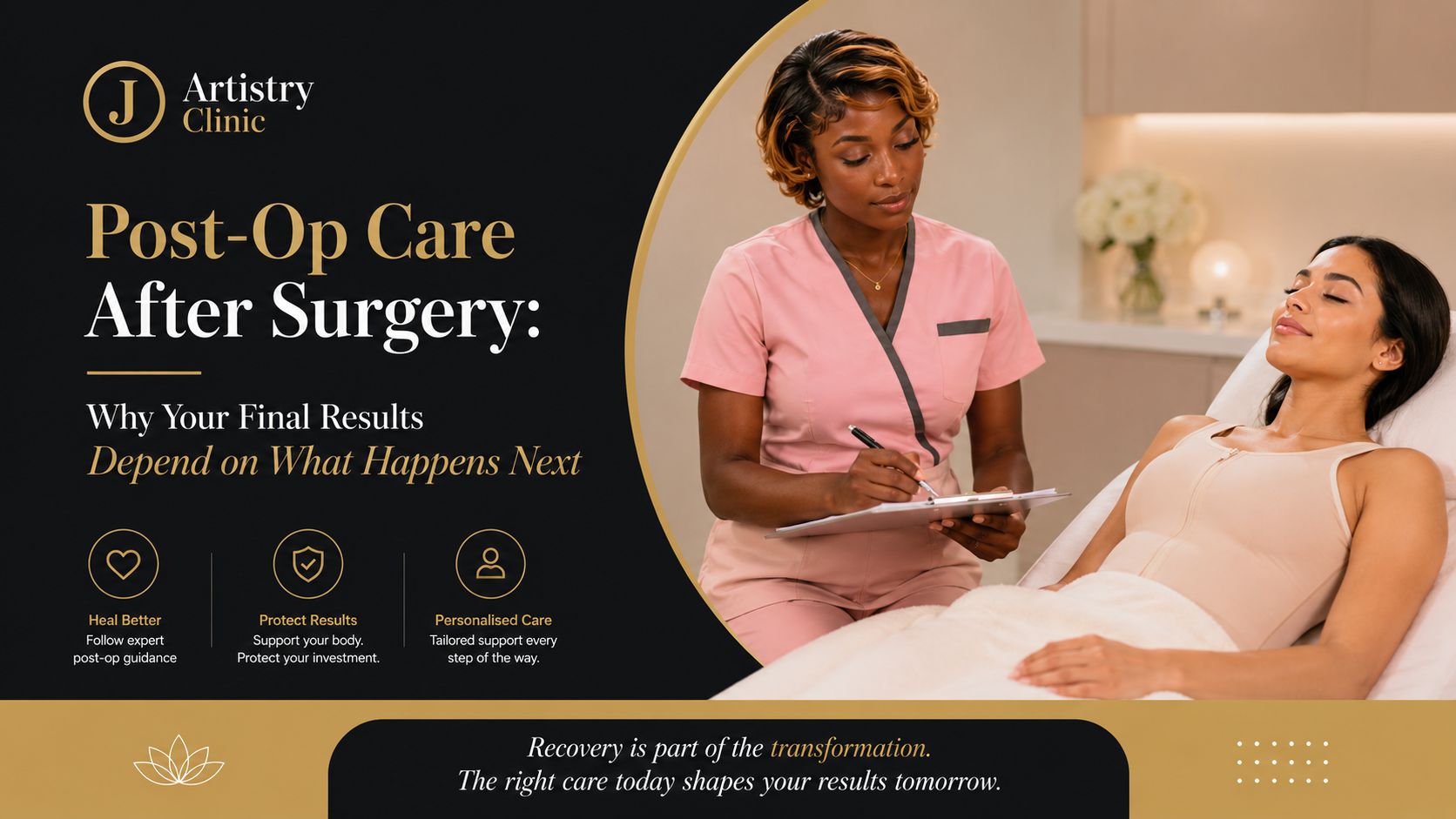
Post-Op Care After Surgery: Why Your Final Results Depend on What Happens Next
In my years of clinical practice, the most difficult conversations I have aren’t about surgeries that went wrong.
They’re about surgeries that went perfectly well, and results that still fell short of what the person was hoping for.
A skilled surgeon. A well-planned procedure. The right clinic. Everything done correctly.
And then the client came home and the post-op care just didn’t happen.
Not because they were careless. Because nobody had told them (clearly, specifically, clinically) how much what happened in the weeks after surgery would determine what they saw in the mirror at month three, six, and twelve.
I’m Joanna Karto, founder of J Artistry Clinic in Coventry. I’m an NHS-trained healthcare practitioner with five years of clinical experience and a specialist background in post-operative recovery, supporting clients through liposuction, BBL, mommy makeover, and male surgery aftercare.
This guide covers everything your surgeon’s leaflet probably didn’t: what’s happening inside your body, what you’ll see when you wake up each morning, what goes wrong without proper care, and what evidence-based post-op care actually involves.

Written by
Joanna Karto
Founder & Healthcare Practitioner · J Artistry Clinic, Spon End, Coventry
NHS-Trained · VTCT Accredited · 5 Yrs Clinical Experience
Published 14 June 2026 · Reviewed and updated 8 October 2026 · Every claim checked against the original source · Next review: January 2027
⭐ 4.8 / 5 · based on verified client reviews
📋 What This Guide Covers
- Why post-op care determines your final result
- What your body goes through after surgery, the four healing stages
- What you wake up to: body changes day by day
- What happens when post-op care is skipped
- Post-op care protocols, surgery by surgery
- What surgeons recommend about post-operative care
- The J Artistry Clinic approach, clinical recovery, not just massage
- What to expect at your post-op sessions in Coventry
- When to seek urgent medical advice
- Frequently asked questions
This article is written for informational purposes by a qualified healthcare practitioner and does not constitute personalised medical advice. Individual results and healing timelines vary. Always follow your surgeon’s specific post-operative instructions. If you develop signs of infection, significant pain, or unexpected symptoms, contact your surgeon or seek medical attention promptly.
Had surgery recently or planning ahead? Speak with Joanna about a personalised post-operative care plan before or after your procedure.

Post-operative recovery care at J Artistry Clinic, Coventry, clinical lymphatic drainage, fibrosis management, and personalised aftercare from an NHS-trained practitioner.
Why Post-Op Care Is As Important As the Surgery Itself
Clinical Summary
Surgery creates the structural change. Post-op care determines how your body heals around that change. A surgeon’s skill controls what happens in the theatre: but what happens in the weeks after determines the visible outcome. The two are inseparable. Skipping post-operative care after liposuction, BBL, or a mommy makeover is clinically equivalent to building a house and not finishing the roof.
Your surgeon’s job ends when you leave the theatre.
Your body’s job (the long, slow, complex biological process of healing around the changes that were made) has only just begun.
Cosmetic surgery creates real, significant trauma to the tissue beneath the skin. Cannulas pass through fat, disrupting the lymphatic network. Incisions are made and closed. Fat is removed, transferred, sculpted. Blood vessels are disturbed. The body responds immediately, with inflammation, fluid, internal restructuring that takes months to complete.
Whether that healing process produces a smooth, even, well-contoured result or a result marked by fibrosis, asymmetry, and hardened tissue depends significantly on the support that process receives.
That support is post-operative care. And it isn’t optional.
Peer-reviewed literature consistently supports the role of manual lymphatic drainage (MLD) in reducing post-operative oedema, preventing fibrosis and adhesion formation, relieving pain, and improving the long-term cosmetic outcome of body contouring procedures. The British Lymphology Society recognises MLD as the primary clinical intervention for post-surgical oedema management in suitable patients.Source: British Lymphology Society · PubMed, Post-operative lymphatic drainage and body contouring outcomes
What Your Body Goes Through After Surgery: The Four Healing Stages
Clinical Summary
The body heals in four biologically distinct stages after surgery, from initial blood clotting through to final tissue remodelling that can take up to six months or longer. Understanding which stage you are in at any given point determines the right type and intensity of post-operative care. Getting it wrong (wrong pressure, wrong timing, wrong technique) can disrupt healing at a critical moment.
Your body doesn’t heal in a straight line. It heals in four overlapping stages, each with its own biology, its own risks, and its own specific care requirements.
This is what’s happening beneath your skin, from the moment you wake up in recovery to the day your final result settles.
1
Hemostasis
Days 1–2
Blood vessels constrict. Platelets form clots. The body seals the surgical wound from within. This stage is automatic: your role is rest, compression, and nothing that raises blood pressure.
2
Inflammation
Days 3–14
Swelling peaks. White blood cells flood the area. The lymphatic system is overwhelmed and begins to back up. This is when post-op care is most urgently needed, and most impactful.
3
Proliferation
Weeks 2–6
New collagen forms to repair tissue. This is the fibrosis window, where scar tissue either integrates smoothly or begins to harden into lumps and adhesions if drainage isn’t maintained.
4
Remodelling
Weeks 6–24+
Collagen matures, tissue softens, swelling resolves progressively. Your final result gradually emerges. Ongoing care during this phase protects and refines the outcome.
Most people are only told about Stage 1, rest and compression.
Stages 2, 3, and 4, the stages where the final result is actually determined, are where post-operative care has the greatest impact.
What You Wake Up To: How Your Body Changes Day by Day
Clinical Summary
The most disorienting part of post-surgical recovery is the daily variation. You will not wake up to a linear improvement. You will see swelling peak before it reduces, firmness appear before it softens, and days of visible progress followed by apparent setbacks. Every one of these is part of normal biological healing: but understanding what you’re seeing is essential to responding correctly rather than panicking or, crucially, pushing too hard too soon.
Almost every client I see in the first week after surgery asks the same question: “Is this normal? It looks worse than yesterday.”
The answer is almost always yes. Here is what you are likely to experience, and what it actually means.
Hours
1–48
Significant Swelling, Tightness, Soreness
The treated area is swollen, firm, and sore. Bruising may be extensive. This is normal surgical inflammation, the body responding to internal trauma. Your compression garment is doing critical work here. Do not remove it except as instructed by your surgeon.
Days
3–5
Swelling Peaks: This Is the Highest Point
This is usually when people worry most. Swelling peaks at 48–72 hours and can continue through day five. You may look larger in the treated area than before surgery. This is fluid accumulation and is expected. It is not a sign that something has gone wrong.
Days
7–14
Numbness, Lumps, Uneven Texture Appearing
The area may feel numb, tight, or wavy beneath the skin. Firm lumps can begin to appear as the body starts building collagen. These are the early signs of fibrosis forming, the window where post-operative lymphatic drainage is most effective at preventing them from hardening further.
Weeks
2–4
Swelling Reduces in Waves: Not Consistently
Swelling does not reduce smoothly. You may notice visible improvement one day and look more swollen the next, particularly after activity, heat, or a long day on your feet. This is normal. The lymphatic system is clearing fluid gradually and non-linearly.
Weeks
6–12
Result Begins to Emerge: Fibrosis Risk Ongoing
The contour begins to settle. Many clients feel encouraged at this stage. But firmness, unevenness, or hardened areas that have developed in weeks two to six still need active clinical management: they do not always resolve without targeted treatment.
Month
3–6
Final Result Becoming Visible
Most swelling has resolved. The tissue has softened. The true result of your surgery is now visible, and it reflects both the surgeon’s skill and the quality of care your body received during healing. Maintenance post-op care sessions continue to refine and protect the result during this phase.
What Happens When Post-Op Care Is Skipped
Clinical Summary
Skipping post-operative care does not mean you simply heal more slowly. It means your body heals without guidance, and in the absence of structured drainage, compression management, and fibrosis intervention, the healing process produces its own outcomes. These outcomes include hardened scar tissue, fluid pockets, asymmetry, and skin irregularities that are significantly harder and more expensive to address once established.
I want to be direct about this section, because I think it’s the most important thing anyone preparing for or recovering from surgery can understand.
Skipping post-op care after surgery is not a neutral decision. The body doesn’t sit and wait for you to decide you’re ready to start recovery. It heals whether you support it or not, and without guidance, it heals into whatever pattern the undirected biology creates.
Fibrosis
Hard scar tissue forms beneath the skin when collagen production isn’t modulated by drainage. Can persist for years without specialist treatment, in some cases up to a decade.
Seroma
Pockets of fluid accumulate when the lymphatic system cannot clear surgical debris. Seromas that aren’t resolved early significantly increase fibrosis risk and may require medical drainage.
Asymmetry
Where fluid accumulates and fibrosis forms unevenly, the treated area can heal asymmetrically: producing contour differences that were not present immediately after surgery.
Prolonged Swelling
Without drainage to support the lymphatic system, swelling that should resolve in weeks can persist for months, delaying the visible result and causing ongoing discomfort.
Skin Irregularities
Lumps, banding, waviness, and surface irregularities beneath the skin: which appear when fibrosis and uneven tissue remodelling aren’t addressed during the healing window.
Revision Surgery Risk
Where fibrosis and asymmetry are severe and left untreated, some clients ultimately require revision surgery to correct outcomes that could have been significantly mitigated by proper aftercare.
“In the last two decades I have seen hundreds of post-liposuction fibrosis cases. In some cases I saw fibrosis disappear with little effort, and in other cases I saw people suffering from fibrosis ten years after surgery. Most surgeons either don’t mention fibrosis at all, or underplay its extent and importance.”
Georgios Tzenichristos, LipoTherapeia, London, cited in LipoTherapeia clinical commentary on post-liposuction fibrosis
Had surgery recently, or returning from surgery abroad? Joanna will assess where you are in your healing and build a plan around your specific procedure and timeline.
Post-Op Care Protocols: Surgery by Surgery
Clinical Summary
Every surgical procedure creates a different pattern of trauma, disrupts different anatomical structures, and requires a different post-operative care approach. A BBL and a liposuction procedure are fundamentally different in their recovery needs. A mommy makeover, combining multiple procedures, requires a staged, integrated approach. The protocols below reflect current clinical consensus, though individual care plans should always be tailored to the specific procedure and person.
There is no single post-operative care protocol that applies to every surgery.
What your body needs after liposuction is different from what it needs after a BBL. What a male gynecomastia patient requires is different from a mommy makeover patient recovering from three combined procedures.
Here is the evidence-based approach for each of the most common procedures we support at J Artistry Clinic.
After Liposuction: Standard Lipo and Vaser Lipo
- Start post-op care: within 24–72 hours, subject to surgeon approval
- Frequency: 2–3 sessions per week for the first month
- Compression garments: worn consistently for 6–8 weeks, day and night initially
- Primary focus weeks 1–3: lymphatic drainage, fluid management, swelling reduction
- Primary focus weeks 3–8: fibrosis prevention, tissue normalisation, compression guidance
- Primary focus weeks 8+: fibrosis management where present, progressive softening, maintenance
- Common areas: abdomen, flanks, arms, thighs, back. All require coverage in the drainage sequence
After BBL (Brazilian Butt Lift): Fat Harvest + Transfer
- Start post-op care: within 24–72 hours for donor sites; fat transfer site requires specific care
- Critical rule: no direct compression or pressure to the fat transfer site during the viability window (4–6 weeks)
- Drainage focus: the liposuction donor sites (abdomen, flanks, back), not the buttocks directly
- Frequency: 8–12 sessions within the first 2–4 weeks; some protocols extend to 15–20 sessions
- Fat cell viability is critical in the first 6–8 weeks: care must actively protect the transferred tissue
- Weeks 6–12: the donor sites’ fibrosis management becomes the primary focus as transfer site heals
After Mommy Makeover: Combined Tummy Tuck, Liposuction & Breast Work
- Start post-op care: 3–7 days post-surgery for gentle drainage, earlier clearance is procedure-dependent
- The tummy tuck component requires careful attention around the incision line: drainage is directed away from sutures
- Abdominal fibrosis management is a priority from weeks two to six given the depth of tissue disruption
- Compression at the abdomen must be consistent and correctly fitted throughout the first eight weeks
- Breast work component: specific drainage sequences to manage chest and axilla swelling; no chest compression where implants are involved
- Staged return to activity is guided clinically after each session
After Male Surgery: Gynecomastia, Liposuction, Tummy Work
- Gynecomastia (chest tissue removal): specific chest compression garments are essential; drainage to the axilla and chest wall
- Male liposuction: same protocols as standard lipo, though men often have thicker tissue requiring adjusted pressure
- Male patients statistically have a higher tendency to develop dense fibrosis: early post-op care is particularly important
- Social stigma sometimes delays men seeking post-op care; this is addressed openly at J Artistry Clinic without judgement
- Recovery milestones (return to gym, sport, physical work) are discussed and planned at each clinical session
What Surgeons Recommend About Post-Operative Care
Clinical Summary
The majority of board-qualified plastic and aesthetic surgeons recommend manual lymphatic drainage and structured post-operative care as a standard part of recovery from liposuction, BBL, tummy tuck, and body contouring surgery. The challenge is that surgeons discharge patients with general guidelines but are rarely in a position to oversee the day-to-day clinical detail of how the body is healing: which is precisely where a dedicated post-op care practitioner adds most value.
Almost every surgeon performing liposuction, BBL, and tummy tuck procedures recommends post-operative lymphatic drainage as part of their standard aftercare protocol.
The language varies (“post-op massage,” “lymphatic drainage,” “recovery therapy”) but the clinical intent is consistent.
What surgeons often cannot do is provide it themselves.
Surgical clinics discharge patients with compression garments, written instructions, and follow-up appointments at one, three, and six weeks. In between those appointments (during the weeks when swelling is peaking, fibrosis is forming, and the body is making its most critical healing decisions) the client is largely on their own unless they have specialist post-op care in place.
At J Artistry Clinic in Coventry, we frequently work alongside the surgeon’s aftercare protocol, filling the clinical gap between discharge and the long-term result.
Peer-reviewed clinical literature confirms that manual lymphatic drainage applied in the post-operative period produces statistically significant reductions in oedema, improves pain levels, and reduces the incidence of fibrosis and adhesion formation. Studies specifically in body contouring patients show improved patient satisfaction scores where structured post-op care is part of the recovery protocol. The Perea Clinic’s published clinical protocols note that treatment should be tailored to the individual stage of healing rather than applied to a fixed schedule.Source: Perea Clinic, Treating Fibrosis After Liposuction, BBL, and Tummy Tuck
A note for clients who have had surgery abroad: particularly in Turkey, which is now one of the most common destinations for liposuction, BBL, and mommy makeover procedures among UK patients:
Returning to Coventry or the UK does not mean your post-op care options are limited.
J Artistry Clinic regularly supports clients who have had procedures in Istanbul, Ankara, and other overseas surgical destinations. The post-operative care your body needs does not depend on where the surgery was performed.
The J Artistry Clinic Approach: Clinical Recovery, Not Just a Massage
Clinical Summary
Post-operative care at J Artistry Clinic in Coventry is a clinical recovery service. After every session, Joanna Karto provides a full clinical overview of how the body is healing, identifying fibrosis, seroma signs, asymmetric tissue development, or healing irregularities that require specific intervention. The treatment plan is adjusted based on what is observed at each appointment. Written clinical notes are kept across every visit. This is not massage. It is medically informed post-surgical recovery support.
This is the part I want to make very clear.
What we provide at J Artistry Clinic is not a post-surgery massage. Framing it that way would significantly undersell what actually happens: and more importantly, it would misrepresent what your body needs.
A regular massage applies surface pressure for relaxation or muscle release. It follows a general protocol regardless of the client’s condition or healing stage.
Post-operative care at J Artistry Clinic is built on a clinical understanding of what the body is doing at each specific stage of surgical recovery. Every session begins with assessment, not treatment.

Clinical assessment at J Artistry Clinic, Coventry: healing progress is measured and documented at every post-op care session, not just at the start and end of the course.
What to Expect at Your Post-Op Sessions at J Artistry Clinic, Coventry
Clinical Summary
Every post-operative care session at J Artistry Clinic follows a structured clinical framework, beginning with assessment, moving through treatment, and concluding with a written overview and specific guidance for the days between sessions. Nothing about the session is fixed by a standard protocol that ignores where you are in your healing journey. Each appointment is a clinical conversation between Joanna and your body.
Here is exactly what happens at a post-op care session at J Artistry Clinic in Coventry.
1
Clinical Assessment of Your Healing
Every session begins with Joanna physically assessing the treated area, feeling for swelling distribution, identifying firm areas, checking compression fit, and asking specific questions about how you have felt since the last appointment. This is a clinical read of where your body is in its healing, not a quick check-in before treatment starts.
2
Manual Lymphatic Drainage: Technique Adapted to Your Stage
The drainage sequence is determined by your current healing stage, not by a fixed protocol. In weeks one to three, the technique is light and focused on moving fluid away from the inflamed zone. From week three onwards, the approach progressively deepens to address fibrosis and promote collagen softening. The precise direction, pressure, and focus of each session is informed by what the assessment found.
3
Fibrosis Management Where Present
Where fibrosis or adhesions are identified, targeted manual techniques are applied to begin breaking down the hardened tissue. This is not a single-session fix: fibrosis management typically requires 6 to 24 sessions depending on severity and stage. Early intervention produces significantly better outcomes than addressing established fibrosis months later.
4
Clinical Overview After Every Session
This is the element that makes J Artistry Clinic’s approach distinct. At the end of every session, Joanna provides a specific verbal and written clinical overview of what she observed during treatment: what is healing well, what needs monitoring, what has changed since the last session, and what the plan for the coming days is. You never leave without understanding exactly where your body is and what to expect next.
5
Personalised Between-Session Guidance
You receive specific, written guidance for the days between sessions, covering compression wear, movement, hydration, what to watch for, and what to avoid based on your current healing stage. This is not generic aftercare literature. It is guidance informed by what Joanna saw in your session that day.
6
Progress Measurement and Plan Adjustment
Body measurements are taken at regular intervals throughout your plan so progress is always objective and documented. If something is healing faster or slower than expected, the plan adjusts. There is no rigid course that continues unchanged regardless of what your body is doing: the plan is always responsive to your actual healing.
When to Seek Urgent Medical Advice During Recovery
Contact Your Surgeon or Seek Medical Attention If You Experience:
- Fever above 38°C at any point during recovery: this may indicate infection and requires prompt assessment
- Increasing pain, redness, warmth, or unusual swelling at the surgical site: signs that require clinical evaluation, not watchful waiting
- Shortness of breath, chest pain, or leg pain and swelling: these can be signs of blood clots and require emergency attention immediately
- Wound opening, leaking, or signs of breakdown at any incision site
- A hard, fluctuant lump appearing rapidly, particularly in the first two weeks: this may be a seroma requiring surgical drainage
- Unusual numbness or tingling that is spreading rather than reducing over time
Post-operative care sessions at J Artistry Clinic supplement your surgeon’s care: they do not replace it. If Joanna identifies anything during a session that she believes requires medical review, she will tell you directly and clearly what to do next.
Recovery Journeys · Real Client Results
See Post-Op Recovery Results From Real J Artistry Clients
Follow J Artistry Clinic’s Instagram for real recovery journeys, including before and after post-op care, client testimonials, and clinical insights into the healing process.
Post-Lipo Recovery
BBL Aftercare
Fibrosis Management
Mommy Makeover Care
Follow J Artistry Clinic on Instagram →
Frequently Asked Questions: Post-Op Care After Surgery
Questions people ask most often, including those appearing in Google’s “People Also Ask” for this topic.
Post-operative care, post-op care: refers to the clinical support your body receives in the weeks and months after cosmetic surgery. It encompasses manual lymphatic drainage, compression garment guidance, fibrosis management, and healing assessment.
It is important because surgery creates trauma that the body must heal systematically. Without structured clinical support, fluid accumulates, fibrosis forms in the healing tissue, and the final result is compromised regardless of how skilled the surgeon was. Surgery creates the structural change. Post-op care determines how your body heals around it.
Most clinical protocols recommend beginning post-op care, specifically manual lymphatic drainage, within 24 to 72 hours after liposuction, subject to your surgeon’s specific approval. Early intervention, while the lymphatic pathways are still partially active, significantly reduces peak swelling and lowers the risk of fibrosis forming in the early healing window.
Waiting more than two weeks substantially reduces the effectiveness of early-stage drainage and allows fibrosis to become more established. At J Artistry Clinic in Coventry, we can begin supporting your recovery within days of your procedure: or from whenever you are ready to start.
Fibrosis after surgery is the formation of hardened scar tissue beneath the skin as the body heals. It occurs when the body produces excess collagen in response to surgical trauma, creating firm lumps, bands, or areas of uneven texture in the treated area.
Fibrosis typically begins developing between weeks one and twelve post-surgery. In some cases, it can persist for years if untreated, with documented cases of fibrosis present ten years after liposuction when no appropriate post-op care was received.
It is prevented through early manual lymphatic drainage, consistent compression garment wear, and structured post-operative care throughout the proliferation phase of healing. Where fibrosis is already present, 6 to 24 specialised treatment sessions may be required depending on severity and how long it has been established.
Skipping post-op care after surgery significantly increases the risk of fibrosis, seroma formation (fluid pockets beneath the skin), prolonged swelling, asymmetry, skin irregularities, and in some cases the need for revision surgery.
The surgical result itself does not guarantee the final appearance. What you see at month three, six, and twelve reflects how your body healed, and how your body healed reflects the quality of the recovery support it received. Post-op care is not optional maintenance. It is the second half of the treatment.
Most clinical protocols recommend 2 to 3 sessions per week for the first month after liposuction, reducing to weekly sessions over months two and three. For more extensive procedures, or where fibrosis has developed, the course may extend further.
The exact number cannot be determined before your clinical assessment, because every body heals differently, every procedure disrupts tissue differently, and every person’s response to post-op care is individual. At J Artistry Clinic in Coventry, Joanna assesses your specific healing before recommending a plan, and adjusts that plan throughout as your body progresses.
Yes: and it is considered a clinical priority, not an optional add-on. The BBL procedure involves both liposuction of the donor sites and fat transfer to the buttocks. Both components create different post-operative needs that must be managed simultaneously and carefully.
The liposuction donor sites need drainage to prevent fibrosis. The overall lymphatic system requires support to manage surgical swelling from both elements. Most clinical protocols recommend 8 to 12 sessions within the first two to four weeks, with some protocols extending to 15 to 20 sessions.
Critically: no direct pressure should be applied to the fat transfer site during the viability window of four to six weeks. This is a clinical distinction that separates post-op care from regular massage: understanding what not to do in a BBL recovery is as important as knowing what to do.
Some degree of swelling after liposuction is normal and expected for three to six months: and in some cases it takes up to a year for the final contour to settle. Swelling does not reduce linearly.
It peaks at 48–72 hours, improves in waves over the following weeks, and stabilises gradually over months. Daily variation is common: swelling is often worse in the morning, after activity, or in heat. Consistent post-operative care significantly reduces both the severity and duration of swelling throughout the recovery period.
Yes: and this is a very common clinical path. A significant number of UK adults travel abroad (particularly to Turkey) for liposuction, BBL, and mommy makeover procedures, then return home and need local post-operative care support.
J Artistry Clinic in Coventry regularly supports clients who have had procedures in Istanbul, Ankara, and other destinations. Post-operative care does not depend on where the surgery was performed. Joanna conducts a full clinical assessment of where you are in your healing journey before designing a personalised recovery plan built around your specific procedure and timeline.
Post-operative care at J Artistry Clinic is a clinical recovery service, not a massage. The distinction matters significantly.
After every session, Joanna provides a full clinical overview of how your body is healing, identifying fibrosis, seroma signs, uneven tissue development, or areas requiring specific attention. Your protocol is adapted based on what is observed at each appointment, not fixed by a predetermined number of sessions. Written clinical notes are kept across every visit. Personalised between-session guidance is provided at each appointment. Measurements are taken regularly to track progress objectively.
The treatment itself, manual lymphatic drainage, uses specific anatomical sequences informed by the lymphatic system’s structure and your healing stage. The pressure, direction, and focus change as your body progresses through healing. It is clinically informed post-surgical recovery: that distinction is what makes the outcome different.
A regular massage applies pressure for relaxation or muscle release. It follows a general protocol regardless of the client’s condition. The practitioner does not need to know anything about your surgical history to deliver a massage: and the massage does not change based on what stage of healing you are in.
Post-operative clinical care uses specific lymphatic drainage sequences that follow the anatomical pathways of the lymphatic system. The approach must be adapted to the type of surgery, the area treated, the healing stage, and what is observed in each session. Applying the wrong pressure at the wrong stage, particularly in the first two weeks after surgery, can displace fluid incorrectly, aggravate forming fibrosis, or disturb healing tissue. Post-op care requires clinical knowledge of surgical recovery. It is not massage by another name.
A mommy makeover typically combines a tummy tuck, liposuction, and breast work, making it one of the more complex procedures in terms of recovery management. Post-operative care should begin as soon as your surgeon gives clearance, typically 3 to 7 days after surgery for gentle lymphatic drainage.
The tummy tuck component requires specific care around the incision line. The abdominal fibrosis management becomes a priority from weeks two to six. The breast work component requires specific chest and axilla drainage while avoiding compression where implants are involved. At J Artistry Clinic in Coventry, every mommy makeover recovery plan is built around the specific procedures performed: it is never a one-size protocol.
Start Your Recovery the Right Way
Book a post-operative care consultation at J Artistry Clinic in Coventry. Whether you’re preparing for surgery, just home from a procedure, or dealing with complications from a recovery that wasn’t properly supported: Joanna will assess where you are and tell you exactly what your body needs next.
Prefer to call? +44 7591 092255: Mon to Sat 10am to 8pm
📍 J Artistry Clinic · Arches Estate, Spon End, Coventry, CV1 3JQApproximately 8 minutes’ walk from Coventry city centre · Same-day appointments available
Privacy Policy
Wellness Resources & References
- British Lymphology Society (2025). Manual lymphatic drainage in post-surgical oedema management. thebls.com
- NHS (2024). Recovery after surgery, guidance for patients. nhs.uk
- Perea Clinic (2024). How do you treat fibrosis after liposuction, BBL or tummy tuck? pereaclinic.com
- Perea Clinic (2024). Fibrosis after liposuction: causes and key factors. pereaclinic.com
- LipoTherapeia, London (2025). What is fibrosis after liposuction, what causes it, how to prevent and treat it. lipotherapeia.com
- Carely Clinic (2026). Lymphatic massage after BBL: a complete guide. carelyclinic.com
- Muñoz-Donoso P., et al. (2015). Ultrasound cavitation versus cryolipolysis for non-invasive body contouring. PubMed. pubmed.ncbi.nlm.nih.gov
- De La Cruz Plastic Surgery (2025). Lumps and fibrosis after liposuction: causes, treatment, and recovery. delacruzplasticsurgery.com
- Dr Balikian (2025). Liposuction recovery guide, timeline and what to expect. drbalikian.com
- NICE (2023). Wound management and post-operative care guidelines. nice.org.uk
- British Association of Aesthetic Plastic Surgeons (BAAPS). Post-operative care and recovery guidance. baaps.org.uk
- Studio for Body (2025). Post-op lymphatic drainage after liposuction, clinical overview. studioforbody.com
- Aesthetic Center for Plastic Surgery (2025). What is fibrosis after liposuction? Causes, treatment and prevention. mybeautifulbody.com
Medical disclaimer. This article is educational and does not replace individualised advice from your GP or a qualified clinician. Read our full medical disclaimer.