Book Appointment

Why Menopause Belly Fat Happens and How to Manage It
Something changes, usually somewhere in your forties or fifties.
You have not started eating differently. Your routine is broadly what it was. The scales say roughly what they have said for years.
And yet your waistbands do not fit, and your middle looks like it belongs to someone else.
Most women describe it in almost identical words: “I am the same weight but a completely different shape.”
That sentence is not imagination, and it is not a failure of willpower.
It is one of the most precisely documented changes in women’s health research, and once you understand what is actually happening, the right response becomes much clearer, and often quite different from what you have been told.
I am Joanna Karto, founder of J Artistry Clinic in Coventry, and an NHS-trained healthcare practitioner.
In five years of clinical practice, this is the conversation I have had more than any other. Nearly every week I sit with a woman who is doing more than she has ever done and getting less back than she ever has, and who has quietly concluded that she must be doing something wrong.
She almost never is.

Written by
Joanna Karto
Founder & Healthcare Practitioner · J Artistry Clinic, Spon End, Coventry
NHS-Trained · VTCT Accredited · 5 Yrs Clinical Experience
Published 21 August 2026 · Reviewed and updated 8 October 2026 · Every figure checked against the original paper · Next review: January 2027 · 19 min read
📋 What This Guide Covers
- What actually happens to your body
- The study that reframes everything
- Is it menopause, or is it ageing?
- Why the fat goes to your abdomen
- The muscle problem nobody mentions
- How to get rid of menopause belly fat
- Best foods for menopause belly
- Foods and drinks to limit
- What exercise actually works
- Does HRT help?
- What about weight-loss injections?
- Sleep, stress and the overlooked drivers
- What does not work, and what harms
- Evidence summary at a glance
- How to measure progress properly
- A realistic 12-week plan
- When to see your GP
- What this guide can and cannot tell you
- Frequently asked questions
- Evidence and sources
Medical disclaimer and scope. This article is an educational resource written by an NHS-trained healthcare practitioner. It is not individualised medical advice and does not replace care from your GP, a menopause specialist or a registered dietitian.
Decisions about HRT belong with your doctor. If you have had any bleeding after the menopause, please see your GP, as that always needs investigation regardless of anything in this guide. Read our full medical disclaimer.
The 30-Second Answer
Why does menopause belly fat happen?
Falling oestrogen changes where your body stores fat rather than simply how much. Fat moves from hips and thighs toward the abdomen, and specifically toward visceral fat around the organs.
At the same time muscle mass declines, which is why your weight can stay almost identical while your shape changes noticeably. This is the single most misunderstood part of menopause belly fat.
The most useful response is not a stricter diet. It is protecting muscle first with resistance training and adequate protein, then applying a moderate calorie deficit, never an aggressive one.
Fat moves, not just increases
Muscle falls at the same time
Protect muscle before cutting
Measure waist, not weight
Want your protein and calorie targets worked out for your body rather than a generic number? Our free tool calculates them and tracks your waist over time, which matters more than the scale here.
What actually happens to your body
📊 Quick summary
Three things happen at once during the menopause transition, and they interact.
One: fat redistributes from hips and thighs toward the abdomen. Two: the rate of fat gain roughly doubles. Three: lean muscle mass starts to decline.
Because fat rises while muscle falls, total weight can look almost unchanged while your body composition changes substantially. That is why the scale is such a poor guide here.
The phrase menopause belly fat makes it sound like one simple thing: you gain weight, and it lands on your middle.
You will see it called plenty of other things too, and the names tell you something.
Menopause tummy, meno belly fat, or simply menobelly as it is often shortened online, are all describing the same experience: a change in the middle that behaves differently to any weight you have carried before.
The reality is more specific, and considerably more useful to know.
Perimenopause, menopause, postmenopause: which one are you in?
These words get used interchangeably, and that causes real confusion, because the body composition changes start earlier than most people expect.
| Stage | What it means | What is happening to body composition |
|---|---|---|
| Perimenopause | Hormones fluctuating, periods changing, still having them. Often begins in the forties. | This is where the accelerated change begins, roughly two years before the final period. Most women searching for answers are here. |
| Menopause | A single point in time: twelve months after your final period. | The steepest part of the curve sits either side of this point. |
| Postmenopause | All the years afterwards. | Roughly 18 months to 2 years after the final period, the accelerated change flattens out. |
So if you are 46, still having periods, and noticing your middle change, you are not too early for this to be relevant. You are likely right in the window where it happens.
And if you are five years past your last period, the underlying push has largely stopped, which means post menopausal stomach fat now behaves much like fat at any other life stage and responds accordingly.
The study that reframes everything
The best evidence we have comes from the Study of Women’s Health Across the Nation, usually shortened to SWAN.
SWAN enrolled 3,302 women across seven sites from 1996. The body composition analysis discussed here drew on 1,246 of those women, the ones with both usable DXA scans and a confirmed date for their final menstrual period, followed across roughly eight years before to ten years after that date.[1]
What it found surprised a great many people, and it is still not widely reported.
What SWAN found across the menopause transition
DXA body composition, analysis sample n=1,246 from the SWAN cohort
Before the transition
Weight climbs steadily and linearly through the premenopausal years. Fat and lean mass both increase.
Transition begins
The rate of fat gain doubles. At the same time, lean mass begins to decline. Body weight itself does not accelerate.
Until ~2 years after final period
Both trends continue. This is the window in which most of the compositional change happens.
After that point
Both trajectories decelerate to near zero. The accelerated phase ends.
The reframe: menopause did not accelerate weight gain in this cohort. Weight climbed anyway, with age. What menopause changed was body composition: more fat, less muscle.[1] Note that this particular analysis measured whole-body composition and did not examine visceral fat, which the authors list as a limitation. The visceral evidence comes from separate research, covered below.
📊 The numbers, precisely
In the average SWAN participant, fat mass rose by about 0.25 kg per year before the transition and 0.45 kg per year during it, roughly a doubling. Lean mass went from gaining about 0.2% a year to losing about 0.2% a year.[1]
Over the transition itself, averaging around 3.5 years, that came to roughly 1.6 kg more fat and 0.2 kg less muscle.
This is not universal. The same analysis found Japanese participants did not show the fat gain during the transition that White and Black participants did, and Chinese participants actually lost fat mass afterwards. There is no single menopause body pattern.[1]
Read that again, because it undoes a lot of guilt.
Much of the gradual weight gain appears to be age-related. The change in body composition is menopause-related.
That is a more careful statement than the version you will see quoted elsewhere, and deliberately so. It does not mean menopause never affects weight for anyone, only that in this cohort the weight curve did not bend at the transition while the composition curve did.
This is precisely why so many women say their weight is stable but nothing fits, and why being told to simply eat less has felt so unhelpful.
💡 The part that is genuinely reassuring
The accelerated phase is time-limited.
In SWAN, the doubled rate of fat gain and the decline in lean mass continued until roughly two years after the final menstrual period, and then flattened to near zero.[1]
That does not mean post menopausal belly fat disappears on its own. It does mean the strong physiological current pushing against you eases considerably, and what you do afterwards works more predictably than what you did during it.
If you are in the thick of it right now, you are working against the steepest part of the curve.
Is it menopause, or is it ageing?
Both, and separating them is genuinely useful because they need slightly different responses.
Driven mainly by ageing
- Gradual, steady weight gain over years
- Slow decline in muscle mass from around your thirties
- Reduced activity levels as life gets busier
- Falling bone density
- Gradual reduction in resting energy needs
Driven mainly by menopause
- Fat shifting from hips and thighs to the abdomen
- The rate of fat gain doubling
- Accelerated loss of lean muscle
- Increased visceral fat specifically
- Reduced energy expenditure and fat oxidation
- Sleep disruption from night sweats
A four-year longitudinal study measured this directly, using CT scanning for abdominal fat and DXA for body composition, in 156 women who were premenopausal at the start.[2]
The finding was clean: middle-aged women gained subcutaneous fat with age, but menopause itself was associated with the increase in total body fat and visceral fat specifically, alongside reduced energy expenditure and reduced fat oxidation.[2]
So abdominal fat and menopause are genuinely linked, not coincidentally connected.
Put plainly, the relationship between menopause and stomach fat is real and measurable, and post menopausal stomach fat has a different underlying cause to the weight you may have gained in your thirties, which is exactly why the approach that worked then works less well now.
Why the fat goes to your abdomen
Oestrogen influences fat distribution. While levels are high, fat is preferentially stored around the hips, bottom and thighs, which is the pattern most women recognise from their twenties and thirties.
As oestrogen falls, that preference weakens. What matters is not just the absolute level but the ratio of testosterone to oestradiol, which shifts as oestrogen declines faster than testosterone.[3]
A higher testosterone-to-oestrogen ratio favours a more central, abdominal pattern of fat storage, closer to the way men typically store fat.
This is why menopause abdominal fat looks and behaves differently to the weight you may have carried before.
The menopause abdomen is not simply a bigger version of your old one. It is a different distribution of fat, driven by a different hormonal environment.
🔍 Why visceral fat specifically matters
The fat accumulating is disproportionately visceral fat, which sits deep around the organs rather than under the skin.
That distinction is not cosmetic. Visceral fat is metabolically active tissue, more strongly associated with type 2 diabetes, cardiovascular disease and metabolic syndrome than subcutaneous fat.
The genuinely encouraging part is that visceral fat also tends to be more responsive to combined dietary and activity change than subcutaneous fat is. It often reduces earlier than the mirror suggests.
Our guide to visceral fat and what makes belly fat hard to shift explains the difference in full.
The muscle problem nobody mentions
If you take one practical thing from this guide, please let it be this section.
Almost all menopause belly advice focuses on losing fat. Very little of it mentions that you are simultaneously losing muscle, and that this is arguably the more consequential change.
A 2026 review in The Obstetrician & Gynaecologist, the RCOG’s own journal, examined the evidence for HRT, testosterone, resistance training and nutrition in preserving muscle mass through menopause, reflecting how seriously this is now taken clinically.[4]
Why it matters so much:
- Muscle is where you store and dispose of glucose, so losing it worsens insulin sensitivity
- Muscle loss reduces the energy you burn at rest, making everything harder
- Muscle and bone are linked, and bone density is already falling at this stage
- Muscle is what keeps you strong, mobile and independent in later decades
There is a further point that changes how you should eat.
With age, muscle becomes less responsive to protein, a phenomenon called anabolic resistance. You need more protein per meal than you used to in order to trigger the same muscle-building response.
⚠ Why crash dieting is genuinely risky here
An observational analysis from SWAN found that lean mass loss and fat mass gain during the menopause transition were associated with subsequent bone mineral density and fracture risk.[5] That is an association rather than proof that dieting causes fractures, and it is worth being precise about the difference.
What it does support is caution. Aggressive or poorly planned restriction, particularly without enough protein, without adequate calcium and vitamin D, and without resistance training, risks losing lean mass at a stage when muscle and bone are already declining.
If you already have osteoporosis or are at raised fracture risk, weight loss should be planned with a clinician or registered dietitian rather than attempted alone.
For most healthy women, a moderate deficit of roughly 250 to 500 kcal below maintenance, alongside adequate protein and resistance training, is both safer and more effective than a steeper cut.
Not sure whether what you are experiencing is menopause, thyroid, or something else? Several conditions produce a similar picture, and a clinical assessment can help you work out which conversation to have.

How to get rid of menopause belly fat
Everything above explains why it happens. This is the part where it becomes a plan.
Before the detail, here is the whole approach in one place, in the order that matters. If you only read one section, read this one.
✅ The ten-step framework
1. Protect muscle first. Resistance training twice weekly, before any calorie cutting.
2. Raise protein. Roughly 1.2 to 1.6 g per kg daily, spread across meals.
3. Only then create a deficit. Moderate, around 250 to 500 kcal, never aggressive.
4. Build meals Mediterranean-style. Vegetables, pulses, wholegrains, oily fish, olive oil.
5. Add aerobic activity. Toward 150 minutes weekly, whatever you will actually do.
6. Get fibre up. Toward 30g daily, which most UK adults miss.
7. Treat sleep as part of the plan. Not an afterthought.
8. Reduce alcohol. Often the single highest-yield change.
9. Measure your waist, not just your weight. Consistently, every 4 to 6 weeks.
10. Get symptoms treated. If hot flushes and broken sleep are wrecking your week, that is a GP conversation, and it makes everything else easier.
Notice what is not on that list: detoxes, cutting out food groups, fasting protocols, and anything described as resetting your hormones.
Each step is expanded below. If you want the underlying detail on any of them, our guides to the best diet to lose belly fat and the best exercises to lose belly fat go deeper on steps two to six, and our guide to clinical fat reduction options covers what is available once the foundations are genuinely in place.
Can you actually get rid of menopause belly?
Honestly, partly.
You can meaningfully reduce abdominal and visceral fat at any age, and visceral fat in particular responds well to combined dietary and activity change. Many women see a genuine difference in how they look and feel.
What is less realistic is returning to precisely the fat distribution you had at thirty, because the hormonal environment that produced it has changed permanently.
I would rather say that plainly than sell you something else. The women who do best are the ones aiming at strength, health markers and how clothes fit, rather than at a body they had two decades ago. That framing also happens to produce better adherence, which produces better results.
Best foods for menopause belly
There is no food that targets abdominal fat, and any article claiming otherwise is selling something.
What genuinely changes at this stage is what your diet needs to prioritise, and that shift is real.
Stronger evidence Supported by randomised trials or large consistent cohorts.
Moderate evidence Supported by observational research or smaller trials.
Supporting role Sensible for overall health, weak direct evidence for abdominal fat.
Protein at every meal Stronger evidence
This is the highest-value change most women can make, and it is the one most often missed.
Aim for roughly 1.2 to 1.6 grams of protein per kilogram of body weight daily, spread across three or four meals rather than concentrated in the evening. For a 70kg woman that is around 84 to 112 grams a day, which usually works out at a protein-containing portion of roughly 25 to 35 grams at each meal, adjusted for your body size and needs.
The per-meal amount matters because of anabolic resistance. Spreading protein across the day appears more effective than loading most of it into the evening, though this is a general direction rather than a precise rule.
⚠ Who should not simply apply these protein targets
These figures are for generally healthy adults. Please get individual advice first if you have chronic kidney disease or reduced kidney function, significant liver disease, are frail or underweight, or are on medical nutrition therapy for any condition.
In kidney disease particularly, protein requirements are often set lower, not higher, and are decided individually by a renal dietitian.
🥚
EggsFast, filling, ~6g each🐟
Oily fishProtein plus omega-3🥛
Greek yoghurtHigh protein, calcium🫘
Beans & lentilsProtein plus fibre🍗
Chicken or turkeyLean, versatile🧀
Cottage cheeseVery high protein per 100gA Mediterranean-style pattern Stronger evidence
Vegetables, pulses, wholegrains, oily fish, olive oil and nuts, with limited processed food. It has the strongest overall evidence of any dietary pattern for cardiometabolic health, which matters more after menopause because cardiovascular risk rises.
Our evidence-based guide to the best diet to lose belly fat covers this pattern in full detail, including a 7-day meal plan you can adapt.
What is the best menopause belly diet?
There is no special menopause belly diet that selectively burns abdominal fat, and no reputable source will tell you otherwise.
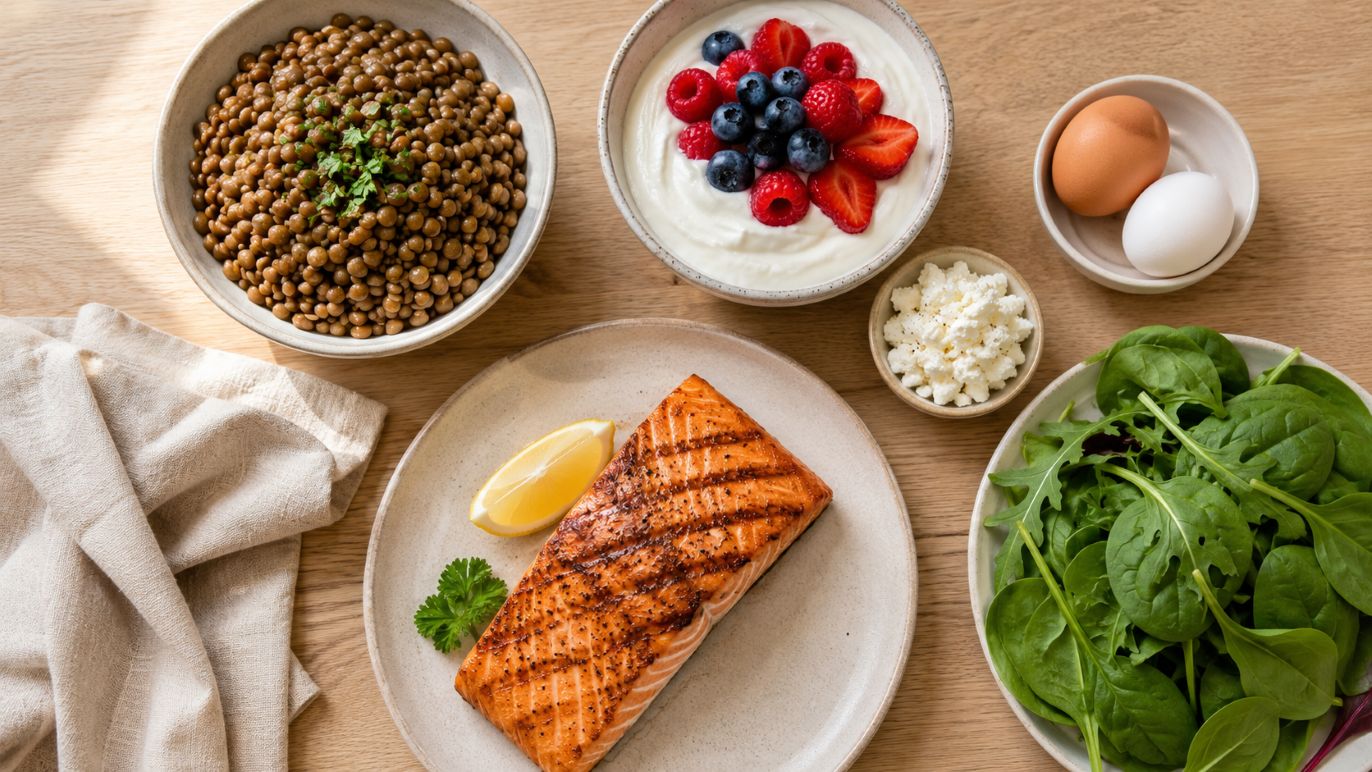
What works is a protein-rich, fibre-rich, minimally processed pattern that supports muscle while allowing a moderate deficit. In practice that looks like this at each meal:
🍽 The menopause plate
Half the plate: vegetables or salad
A quarter: protein, around 25 to 35g
A quarter: wholegrain or starchy carbohydrate
Plus: a small amount of unsaturated fat, such as olive oil or nuts
Five meals that fit it, without anything unusual in the shopping basket:
- Eggs on wholegrain toast with grilled tomatoes and mushrooms
- Greek yoghurt with oats, berries and a spoon of nuts
- Salmon or mackerel with new potatoes and green vegetables
- Chicken or tofu with brown rice and a large salad
- Lentil or bean stew with wholegrain bread
Fibre, and more of it Moderate evidence
Fibre supports fullness, blood glucose control and gut health, and most UK adults fall well short of the 30g daily recommendation. Beans, oats, pulses, vegetables and wholegrains are the practical sources.
Calcium and vitamin D Stronger evidence, for bone
Not for menopause belly weight, but included deliberately because bone loss accelerates now. The NHS recommends considering a daily vitamin D supplement through autumn and winter for all UK adults.[6]
Foods and drinks to limit
Searches for foods to avoid for menopause belly fat usually turn up long lists of banned items. That approach tends to backfire, so here is a priority order instead.
Limit most consistently
- Alcohol, which is calorie-dense, disrupts sleep, and worsens hot flushes for many women
- Sugar-sweetened drinks, which add calories without protein, fibre or satiety
- Ultra-processed snack foods, typically low in the protein and fibre you now need more of
Alcohol is the one I would look at first, because it hits sleep as well as calories, and sleep is doing more work here than most people realise. The NHS unit guidance is a useful reality check on how quickly it adds up.
Moderate
- Refined carbohydrates where a wholegrain version exists
- Processed meat
- Caffeine late in the day, which matters more if sleep is already disrupted
Do not needlessly eliminate
- Carbohydrates as a category, including potatoes, rice, bread and pasta
- Dairy, which is a useful calcium and protein source right now
- Whole fruit
- Fat, particularly unsaturated fats
Restriction is the instinct at this stage and it is usually the wrong one. Eating too little accelerates the muscle and bone loss already underway.
What exercise actually works
🏋 The short answer
Both resistance and aerobic training, because they do different jobs.
A systematic review and meta-analysis of exercise training in postmenopausal women found greater benefit for fat mass outcomes from aerobic training, and greater benefit for muscle mass outcomes from resistance training.[7]
Menopause involves both fat gain and muscle loss. Doing only one addresses half the problem.
Resistance training, twice a week minimum Stronger evidence
This is the part I would prioritise most, and it is the piece most women skip.
It is the most direct way to counter the muscle loss described earlier, and it loads bone, which matters because bone density is falling at the same time. Adequate protein matters alongside it; neither works as well alone.
It does not require a gym. Bodyweight work, resistance bands and a pair of dumbbells at home all count, provided the effort is genuinely challenging by the last few repetitions.
Aerobic activity, 150 minutes a week Stronger evidence
Brisk walking, cycling, swimming or dancing. This is where the fat mass benefit comes from, and it is also the more sustainable half for most people.
🏥 UK physical activity guidance
The UK Chief Medical Officers recommend adults do at least 150 minutes of moderate intensity activity a week, plus strengthening activities on at least two days a week that work all the major muscle groups.[8]
Notice that the strength component is in the official guidance, not an optional extra. Most people do the cardio half and skip the strength half.
Our companion guide covers the best exercises to lose belly fat, selected for their effect on visceral fat, with a full weekly structure you can follow.
For the wider picture across diet, sleep, stress and clinical options, see our main guide to the best way to lose belly fat. If you are new to us, our clinic overview explains the support available beyond articles.
Work out your numbers before you change anything
Guessing your protein target is how most women end up under-eating protein by 30 grams a day. Our free My Fitness Tracker calculates your protein, calorie and fibre targets from your own measurements, then tracks waist alongside weight so you can see composition change rather than just the scale.
Use My Fitness Tracker →Does HRT help with menopause belly fat?
⚠ Read this part carefully
HRT is not a weight loss treatment and should never be taken for that reason.
The decision about hormone therapy belongs with your GP, based on your symptoms, your medical history and your own informed choice.
With that established, the honest evidence position is more interesting than either extreme you will read online.
The OsteoLaus cohort study found that menopausal hormone therapy was associated with lower total and visceral adipose tissue, and with prevention of the age-associated gain in fat mass.[9]
That is an observational finding, which means it shows an association rather than proving HRT caused the difference. Women who take HRT may differ in other ways.
There is also an indirect route that gets less attention: HRT can improve sleep, mood, joint pain and hot flushes, and when those improve, women tend to move more and eat more consistently. That effect is real even if it is not a direct metabolic one.
NICE guideline NG23 supports a clinical diagnosis of menopause in women over 45 without routine blood testing, and frames HRT around informed discussion of individual risks and benefits.[10]
If menopausal symptoms are affecting your life, that is reason enough to have the conversation. Body composition should not be the deciding factor either way.
What about weight-loss injections?
This question comes up in almost every consultation now, so it deserves a straight answer rather than silence.
⚠ Scope, stated plainly
J Artistry Clinic does not prescribe or supply weight-loss medication. Nothing here is a recommendation to take it, and nothing here is a recommendation against it.
These are prescription-only medicines. Whether they are appropriate for you is a decision for a prescriber who knows your full medical history.
GLP-1 and dual GLP-1/GIP medicines, which you will know by brand names such as Wegovy and Mounjaro, are now widely discussed in the context of midlife weight change. Here is what is fair to say.
| Option | What it may help with | What it does not do | Who decides |
|---|---|---|---|
| HRT | Menopausal symptoms; observational evidence associates it with lower visceral fat | It is not a weight-loss treatment and should not be taken as one | GP or menopause clinician |
| GLP-1 / GIP medicines | Overall weight management in people meeting clinical eligibility criteria | Does not target belly fat specifically; can reduce muscle as well as fat without protein and resistance training | Prescriber, against NICE and local criteria |
| Supplements | Correcting a genuine deficiency, such as vitamin D | No good evidence for targeted abdominal fat loss | GP, pharmacist or dietitian |
Three points that matter specifically at this life stage.
They are not menopause treatments. They act on appetite and weight generally, not on the hormonal redistribution described in this guide.
Muscle loss is the relevant risk. Rapid weight loss from any cause reduces lean mass alongside fat. Given that menopause is already reducing lean mass, adequate protein and resistance training matter more on these medicines, not less.
Weight tends to return after stopping unless the surrounding habits are genuinely in place, which is another argument for building the foundations in this guide either way.
If you want to explore this, that conversation belongs with your GP or an appropriately regulated prescriber, not with an aesthetics clinic. I would rather tell you that than pretend otherwise.
Sleep, stress and the overlooked drivers
These two get treated as soft additions to the end of articles. In menopause they are closer to central.
Sleep Moderate evidence
Night sweats and disrupted sleep are among the most common menopausal symptoms, and poor sleep independently worsens appetite regulation, insulin sensitivity and the motivation to train.
Research has also found that visceral fat plays an independent mediating role in the increased rate of obstructive sleep apnoea seen after menopause, beyond BMI alone.[11]
If you snore heavily, wake unrefreshed, or your partner has noticed you stop breathing, please mention it to your GP, since sleep apnoea is treatable. Sleep apnoea is underdiagnosed in women and treating it changes everything downstream.
Stress and cortisol Moderate evidence
Visceral fat carries a higher density of cortisol receptors than fat elsewhere, which is the usual mechanism offered for stress driving abdominal storage.
That said, I would be cautious with this one. A great deal of low-quality content presents cortisol as the explanation for menopause belly fat, and the evidence does not support that. Stress and poor sleep genuinely influence appetite, activity and glucose regulation, which matters. Cortisol as a single cause does not.
This life stage often coincides with caring for teenagers, ageing parents and peak career demands simultaneously, which is not a coincidence worth ignoring.
What does not work, and what actively harms
| Approach | Why it appeals | What actually happens |
|---|---|---|
| Very low calorie diets | Fast initial weight loss | Accelerates muscle and bone loss at the worst possible time. Weight returns, composition is worse. |
| “Meno belly” supplements | Targeted marketing to a specific frustration | No good evidence for abdominal fat reduction. Money better spent on protein. |
| Endless cardio only | Familiar, and it worked before | Addresses fat but not muscle loss, so composition keeps drifting. |
| Abdominal exercises alone | Feels targeted | Builds muscle under the fat, does not reduce the fat. Spot reduction is not possible. |
| Cutting out carbohydrates entirely | Simple rule, quick water loss | Often reduces fibre badly, hard to sustain, no advantage over a moderate approach. |
| Weighing yourself daily | Feels like control | The least informative measure at this stage, because fat and muscle move in opposite directions. |
The pattern across all six is the same: they either ignore muscle, or actively cost you muscle.

Evidence summary at a glance
Every recommendation in this guide, graded by how strong the underlying evidence actually is.
| Recommendation | Evidence | Why it matters here |
|---|---|---|
| Resistance training, 2+ times weekly | Stronger | Counters the lean mass loss specific to the transition; loads bone |
| Adequate protein, 1.2–1.6 g/kg | Stronger | Supports muscle retention during a deficit |
| Aerobic activity, 150 min weekly | Stronger | Meta-analysis favours it for fat mass outcomes |
| Mediterranean-style pattern | Stronger | Best cardiometabolic evidence, and risk rises after menopause |
| Moderate rather than steep deficit | Moderate | Protects lean mass and bone at a vulnerable stage |
| Improving sleep | Moderate | Affects appetite regulation and insulin sensitivity |
| Reducing alcohol | Moderate | Calories plus sleep disruption plus hot flushes |
| HRT for symptoms | Stronger, for symptoms | Not a fat-loss treatment; body composition evidence is observational |
| Supplements marketed for meno belly | Insufficient | No good evidence for targeted abdominal fat loss |
| Abdominal exercises for spot reduction | Not supported | Spot reduction is not physiologically possible |
How to measure progress properly
Because fat and muscle move in opposite directions here, the bathroom scale is an incomplete measure on its own, particularly in the first few months. It still has a place, but not as your only measure.
📏 Waist measurement protocol
- Measure against skin or one thin layer, never over clothing.
- Find the midpoint between the bottom of your ribs and the top of your hip bone, and use that same point every time.
- Stand relaxed with your arms at your sides.
- Breathe out normally and measure at the end of that breath. Do not hold your breath or pull your stomach in.
- Keep the tape level and snug without compressing the skin.
- Take two readings and record the average.
- Measure at the same time of day, ideally in the morning before eating.
- Reassess every 4 to 6 weeks, never daily.
Alongside waist, track things the scale cannot show you:
- Strength. Are you lifting more than eight weeks ago, or managing more repetitions?
- How clothes fit, particularly waistbands.
- Energy and sleep quality.
- Weekly average weight, not any single morning.
Waist-to-height ratio is the additional check worth adding, and current NICE guideline NG246 encourages adults with a BMI under 35 to measure it themselves.[12]
Divide your waist by your height. A ratio of 0.5 or above indicates increased health risk and is worth raising with a healthcare professional.
Waist-to-hip ratio is a further option some clinicians use, dividing waist by hip circumference, where a value above roughly 0.85 in women suggests a more central fat distribution.
🌎 An important ethnicity note
NG246 sets lower BMI thresholds for people of South Asian, Chinese, other Asian, Middle Eastern, Black African or African-Caribbean family background, because central adiposity and its associated risk occur at a lower BMI in these groups.[12]
If that applies to you, the standard charts may understate your risk. It is worth mentioning at your appointment.
⚠ What a tape measure cannot do
Waist circumference is a proxy. It cannot separate visceral from subcutaneous fat, and it does not replace clinical assessment.
Home body composition scales that display a visceral fat rating use bioelectrical impedance, which estimates rather than measures, and readings shift with hydration and time of day. Useful for a trend in yourself, not for a diagnosis.
A realistic 12-week plan
Three phases, because trying to change everything in week one is the most reliable way to be back where you started by March.
Weeks 1–4: Build the base
Add protein to breakfast, aiming for 25 to 30g. This alone changes appetite for the whole day.
Start resistance training twice a week, even if it is 20 minutes with bands at home.
Do not cut calories yet. Take your baseline waist measurement.
Weeks 5–8: Add the deficit
Now apply a moderate deficit, roughly 250 to 500 kcal below maintenance. Not more.
Hit your protein target at every meal, not just breakfast.
Add aerobic activity toward 150 minutes weekly. Reduce alcohol if it is regular.
Weeks 9–12: Consolidate
Progress your resistance training, heavier or more repetitions. This is where muscle is actually protected.
Address sleep deliberately rather than hoping it improves.
Reassess waist and strength. Adjust only if genuinely stalled.
Notice that calorie restriction does not appear until week five. That ordering is deliberate and it is the opposite of how most plans are built.
You are protecting the muscle first, so that the fat loss which follows improves your composition rather than degrading it.
When to see your GP
⚠ Please book an appointment if you have
- Any bleeding after the menopause. This always needs investigation, without exception.
- Abdominal swelling that is persistent rather than fluctuating, particularly if it is new
- Bloating that does not settle, especially with pain or a change in bowel habit lasting more than three weeks
- Feeling full very quickly when eating
- Rapid or unexplained weight change in either direction
- Heavy snoring, or waking unrefreshed, which may indicate sleep apnoea
- Menopausal symptoms that are affecting your quality of life
Persistent bloating in particular is on the NHS list of symptoms warranting assessment in women, because it can occasionally indicate conditions needing prompt investigation. Please do not assume it is simply menopause and tummy fat.
It is also worth asking about thyroid function, since an underactive thyroid produces a very similar picture of weight change and fatigue and is easily tested with a blood test.
If your abdomen feels firm and low rather than soft, and you also have heavy periods or pelvic pressure, our guide on fibroids, belly fat and visceral fat covers a cause that is frequently missed in women of exactly this age group.
What this guide can and cannot tell you
This guide can help you
- Understand why your shape changed when your weight did not
- Know which changes have real evidence behind them
- Prioritise muscle before fat loss, in the right order
- Measure progress in a way that reflects what is happening
- Know what to raise with your GP, and when
- Recognise approaches that will cost you muscle and bone
This guide cannot
- Diagnose menopause, thyroid disease or anything else
- Tell you whether HRT is right for you
- Replace your GP or a menopause specialist
- Account for your medication or medical history
- Tell you your visceral fat level
- Promise a specific result in a specific timeframe
If there is one thing worth carrying away, it is that menopause belly fat is a change in body composition, not a failure of discipline, and the response that works looks quite different from eating less and moving more.
Doing everything right and still not seeing change?
Several conditions produce a picture that looks exactly like menopause, including thyroid dysfunction, insulin resistance and fibroids. They are straightforward to investigate and frequently missed.
Hormonal and metabolic health screening at J Artistry Clinic tests thyroid function, fasting insulin and other markers, so you know what you are actually working with.
J Artistry Clinic · Arches Estate, Spon End, Coventry, CV1 3JQ
Mon to Sat 10am to 8pm · Same-week appointments often available
Prefer to start on your own? Build a free plan with My Fitness Tracker
Mon to Sat 10am to 8pm · Same-week appointments often available
Prefer to start on your own? Build a free plan with My Fitness Tracker
Frequently asked questions
The questions women ask most often about menopause belly fat, answered directly.
Falling oestrogen changes where your body stores fat rather than simply how much it stores. As oestrogen declines relative to testosterone, fat redistributes from the hips and thighs toward the abdomen, and specifically toward visceral fat around the organs.
A four-year longitudinal study using CT and DXA found that menopause itself was associated with increased total body fat and visceral fat, alongside reduced energy expenditure and reduced fat oxidation.
At the same time lean muscle mass declines, which lowers the calories you burn at rest. The combination means many women see their shape change even when their weight does not move much.
Less than most people assume. Analysis of DXA body composition data from the SWAN study, covering 1,246 women with usable scans and a confirmed final menstrual period, found that body weight climbed steadily through midlife without a specific acceleration at the menopause transition.
What changed profoundly was body composition: at the onset of the transition the rate of fat gain doubled while lean mass simultaneously declined.
So the weight gain many women experience is largely age-related, whereas the change in shape and the shift toward abdominal fat is menopause-related.
The accelerated phase appears to be time-limited. In the SWAN analysis, the doubled rate of fat gain and the decline in lean mass continued until roughly two years after the final menstrual period, after which both trajectories decelerated to near zero.
This matters because it means the rapid compositional change is a phase rather than a permanent new normal.
It does not mean abdominal fat disappears by itself, but it does mean the underlying process driving it slows considerably.
Prioritise protein at every meal, aiming for roughly 30 grams per meal from fish, poultry, eggs, Greek yoghurt, tofu, beans or lentils, since protein preserves the muscle that is otherwise declining.
Build the rest of the plate around fibre-rich vegetables, pulses and wholegrains, with unsaturated fats from olive oil, nuts and oily fish. A Mediterranean-style pattern has the strongest overall evidence base.
Calcium and vitamin D matter more than they did previously because bone loss accelerates at this life stage. There is no single food that targets abdominal fat.
Limit sugar-sweetened drinks, highly processed snack foods and alcohol most consistently, since these add calories with little protein, fibre or nutritional value at a stage when nutrient density matters more.
Alcohol deserves particular attention because it also disrupts sleep, and poor sleep independently worsens appetite regulation and insulin sensitivity.
You do not need to eliminate carbohydrates, dairy or fruit. Very restrictive eating is counterproductive here because it accelerates the muscle and bone loss already underway.
HRT is not a weight loss treatment and should not be taken for that purpose. However, observational evidence including the OsteoLaus cohort found menopausal hormone therapy was associated with lower visceral adipose tissue and with prevention of age-associated fat mass gain.
HRT may also help indirectly by improving sleep, mood and joint symptoms, which makes activity and consistent eating easier.
Under NICE guideline NG23, the decision about HRT is based on your symptoms, history and informed choice, discussed with your GP, not on body composition goals.
Both resistance and aerobic training, because they do different jobs. A systematic review and meta-analysis of exercise training in postmenopausal women found greater benefit for fat mass outcomes from aerobic training and greater benefit for muscle mass outcomes from resistance training.
Since menopause involves both fat gain and muscle loss, doing only one addresses half the problem.
UK Chief Medical Officers’ guidance recommends 150 minutes of moderate aerobic activity plus strengthening activity on at least two days per week, which fits this evidence well.
This is one of the most common experiences women describe and it has a clear physiological explanation. During the menopause transition, fat mass increases while lean muscle mass decreases.
Because these move in opposite directions, total body weight can remain relatively stable while body composition changes substantially. At the same time, fat is redistributing from the hips and thighs toward the abdomen.
The result is a genuinely different shape at an almost identical weight, which is why the scale is a poor measure at this life stage and waist circumference is better.
You can meaningfully reduce abdominal and visceral fat at any age, and visceral fat in particular responds well to combined dietary and activity change.
What is less realistic is returning to exactly the fat distribution you had at 30, because the hormonal environment that produced it has changed.
A more useful goal is reducing visceral fat for health reasons, preserving muscle and bone, and improving how you feel and function. Framing it as reversing menopause tends to lead to restrictive approaches that make body composition worse.
There is no supplement with good evidence for reducing abdominal fat specifically in menopause, and products marketed for meno belly generally rely on marketing rather than trial data.
Some supplements have legitimate but different roles: vitamin D and calcium for bone health where intake or status is inadequate, and protein supplementation where dietary protein is genuinely hard to reach.
Speak to your GP or pharmacist before starting supplements, particularly if you take other medication.
See your GP if abdominal enlargement is rapid, persistent rather than fluctuating, accompanied by pain, bloating that does not settle, changes in bowel habit, or feeling full very quickly when eating, as persistent bloating warrants assessment.
Also see your GP if you have any bleeding after the menopause, which always needs investigation.
Separately, it is worth a conversation if menopausal symptoms are affecting your quality of life, since NG23 supports a clinical diagnosis in women over 45 without routine blood testing.
Honest women’s health content, without the hype
Practical guidance on menopause, hormonal belly fat and body composition from an NHS-trained perspective.
Menopause Belly Fat
Muscle & Protein
Visceral Fat
Women’s Health
Follow @jartistryclinic →
References
Every figure has been checked against the original publication. Study type and key limitations are stated so you can weigh the evidence yourself.
- Greendale GA, Sternfeld B, Huang M, et al. Changes in body composition and weight during the menopause transition. JCI Insight, 2019;4(5):e124865. Longitudinal cohort, n=3,302, DXA, 18-year window (SWAN). Observational. The authors note they did not examine regional body composition or visceral fat in this particular analysis. insight.jci.org/articles/view/124865
- Lovejoy JC, Champagne CM, de Jonge L, Xie H, Smith SR. Increased visceral fat and decreased energy expenditure during the menopausal transition. International Journal of Obesity, 2008;32(6):949-958. Observational longitudinal study, n=156 initially premenopausal women, 4 years, visceral fat by CT, body composition by DXA. pubmed.ncbi.nlm.nih.gov/18332882
- Serra FS, et al. Healthy adipose tissue after menopause: contribution of balanced diet and physical exercise. Exploration of Endocrine and Metabolic Diseases, 2025. Review. Describes visceral redistribution driven by a higher testosterone to oestradiol ratio. doi.org/10.37349/eemd.2025.101424
- Campbell, et al. Muscle and the Menopause. The Obstetrician & Gynaecologist, 2026. Review in the RCOG journal, evaluating HRT, testosterone, resistance training and nutrition for preserving muscle mass. doi.org/10.1111/tog.70046
- Greendale GA, Han W, Finkelstein JS, et al. Menopause-Related Changes in Body Composition Are Associated With Subsequent Bone Mineral Density and Fractures: Study of Women’s Health Across the Nation. Journal of Bone and Mineral Research, 2023;38(3):395-402. Cohort analysis, n=539. Observational. pubmed.ncbi.nlm.nih.gov/36542065
- NHS. Vitamin D. National guidance. Recommends considering a daily supplement in autumn and winter. nhs.uk/conditions/vitamins-and-minerals/vitamin-d
- Systematic review and meta-analysis. The effects of exercise training on body composition in postmenopausal women. Frontiers in Endocrinology, 2023. Meta-analysis of randomised and controlled trials. Aerobic training favoured fat mass outcomes; resistance training favoured muscle mass outcomes. frontiersin.org
- UK Chief Medical Officers. Physical activity guidelines for adults aged 19 to 64. Via NHS. National guidance. 150 minutes moderate activity plus strengthening on at least two days weekly. nhs.uk/live-well/exercise
- Papadakis GE, Hans D, Gonzalez Rodriguez E, et al. Menopausal Hormone Therapy Is Associated With Reduced Total and Visceral Adiposity: The OsteoLaus Cohort. Journal of Clinical Endocrinology & Metabolism, 2018;103(5):1948-1957. Observational cohort. Shows association, not causation. HRT is not a weight loss treatment. academic.oup.com/jcem
- National Institute for Health and Care Excellence (NICE). Menopause: identification and management (NG23). Clinical guideline. Supports clinical diagnosis in women over 45 and informed choice regarding HRT. nice.org.uk/guidance/ng23
- Wang Y, Liu H, Zhou B, et al. Menopause and obstructive sleep apnea: revealing an independent mediating role of visceral fat beyond body mass index. BMC Endocrine Disorders, 2025;25:21. Cross-sectional analysis of NHANES data, DXA-quantified body fat distribution. Observational. doi.org/10.1186/s12902-025-01850-2
- National Institute for Health and Care Excellence (NICE). Overweight and obesity management (NG246). Published January 2025. Clinical guideline. Replaces CG189. Encourages self-measured waist-to-height ratio in adults with BMI under 35, with 0.5 or above indicating increased health risk, and sets lower BMI thresholds for several ethnic groups. nice.org.uk/guidance/ng246
- Szeliga A, Chedraui P, Meczekalski B. The Impact of the Menopausal Transition on Body Composition and Abdominal Fat Redistribution. Journal of Clinical Medicine, 2026;15(2):740. Retrospective cross-sectional study, n=325. Covers sarcopenic obesity across the transition. doi.org/10.3390/jcm15020740
- NHS. How to get more fibre into your diet. National guidance. 30g daily recommendation for adults. nhs.uk/live-well/eat-well
- NHS. Menopause: symptoms and treatment. National patient guidance. nhs.uk/conditions/menopause
Corrections and editorial policy. Every statistic in this article was checked against the original published paper before publication on 21 August 2026, and study type and limitations are stated openly. If you spot an error, please contact info@jartistryclinic.com. J Artistry Clinic provides paid clinical services; this article is educational and its guidance does not require any purchase.