Book Appointment


9 Best Ways To Lose Belly Fat for Men
Call it a beer belly. Call it a dad bod. Call it a spare tyre.
Whatever you call it, you have probably noticed it does not shift the way it used to. The same effort that worked at 25 barely moves it at 45.
During my research to write this article, I discovered that most articles on Google about losing belly fat are written for women.
That is not a complaint, it is just true, and it matters, because the advice does not transfer cleanly.
Men store fat differently, carry a different type of it, face different health thresholds, and are considerably less likely to get anything checked before it becomes a problem.
I am Joanna Karto, founder of J Artistry Clinic in Coventry, an NHS-trained healthcare practitioner with five years of clinical experience.
This guide covers what is actually different about belly fat in men, and the nine changes with the strongest evidence behind them.
If you have searched how to lose belly fat as a man and found the same recycled listicle each time, this is the version written from the research rather than from other listicles.
Every figure here has been checked against the original paper rather than a summary, and where evidence is observational rather than experimental, I say so.

Written by
Joanna Karto
Founder & Healthcare Practitioner · J Artistry Clinic, Spon End, Coventry
NHS-Trained · VTCT Accredited · 5 Yrs Clinical Experience
Published 2 September 2026 · Reviewed and updated 8 October 2026 · Every figure checked against the original paper · Next review: January 2027 · 17 min read
☰ What This Guide Covers
- Why belly fat in men is different
- Belly fat, testosterone and when to test
- Know your number: the waist test
- The 9 best ways to lose belly fat for men
- What should men eat to lose belly fat?
- What does not work
- A simple 4-week starter plan
- Where weight-loss injections fit in
- How long it actually takes
- When to see your GP
- What this guide can and cannot tell you
- Frequently asked questions
- Evidence and sources
Medical disclaimer. This article is educational and is not individualised medical advice. It does not replace assessment by your GP, a pharmacist or a registered dietitian.
Speak to a healthcare professional before making significant changes if you take regular medication or have a diagnosed heart, liver, kidney, thyroid or metabolic condition. Read our full medical disclaimer for more.
The 30-Second Answer
How do men lose belly fat?
The mechanism is the same for everyone, a sustained calorie deficit, but the priorities are different for men, and most men’s advice ignores that.
Men store proportionally more visceral fat, the deep fat wrapped around the organs. That is the higher-risk type, and the good news is it responds relatively well to change.
Four of the highest-value changes for most men are cutting the alcohol, getting more protein, lifting weights twice a week, and eating more fibre. And there is a ninth, right at the end, that almost no man does: getting your bloods checked.
Waist beats scales
Alcohol is the big lever
Visceral fat responds first
Get tested, stop guessing
Before you change anything, get your numbers. Our free tool works out your calorie and protein targets and tracks your waist, which matters far more than the scales here.
Why belly fat in men is different
Two men can weigh exactly the same, wear the same size, and carry very different levels of health risk.
The reason is where the fat sits.
| Subcutaneous fat | Visceral fat | |
|---|---|---|
| Where it sits | Directly under the skin | Deep in the abdomen, around the organs |
| Can you pinch it? | Yes | No |
| Typical male pattern | Less of it, proportionally | More of it, proportionally |
| Metabolic risk | Lower, but not harmless | Considerably higher |
| Response to change | Slower | Often responds earlier |
One clarification before the table is misread: subcutaneous fat is not risk-free. It carries less metabolic risk than visceral fat, but a large amount of it usually signals that there is more visceral fat underneath too.
Men typically store fat in what is called an android pattern, centrally around the middle, rather than the hip and thigh pattern more common in premenopausal women.
A greater share of that central fat is visceral. That is why a firm, hard belly in a man is not a sign of being in better shape than a soft one; it can indicate the opposite.
The one genuinely good piece of news
Visceral fat is more metabolically active than subcutaneous fat, which is what makes it risky.
It is also, for the same reason, more responsive to change. It tends to reduce earlier than the fat you can see in the mirror.
Practically, that means your blood pressure, blood glucose and energy often improve before your reflection does. If you judge purely by the mirror in the first few weeks, you will quit before the results arrive.
Belly fat, testosterone, and when testing is appropriate
Nearly every man who raises this with me has heard some version of it, usually from a friend or a podcast, and almost always in the same fatalistic form.
The usual version goes: testosterone drops with age, that is why the belly appears, nothing to be done about it.
The evidence points somewhere considerably more useful than that.
What a 2026 analysis of 4,948 men found
Researchers analysed a cross-sectional sample of 4,948 men from the US NHANES survey, of whom 4,492 had valid DXA-derived visceral fat measurements alongside morning testosterone readings.[1]
Visceral fat was strongly and inversely associated with total testosterone. Crucially, it predicted testosterone better than BMI or waist circumference did.
The authors also noted that adiposity-related factors outweighed chronological age in predicting low testosterone in this age range, which echoes findings from the European Male Aging Study.[1]
That single finding contradicts what most men have been told, so it is worth stating twice.
In this data, the deep belly fat explained low testosterone better than getting older did.
One mechanism often offered is aromatase, an enzyme in fat tissue that converts testosterone into oestradiol, so more fat means more conversion. It is part of the picture rather than the whole of it; the relationship between fat and male hormones is a complex endocrine one, not a single switch.
Lower testosterone may in turn be associated with greater central fat accumulation, although the relationship appears to work in both directions and the evidence cannot tell us which starts it.
⚠ Read this before you draw a conclusion
Having a belly does not mean you have low testosterone. Plenty of men with a high waist have entirely normal levels.
And reducing visceral fat is associated with higher testosterone, but that is not the same as saying weight loss will resolve diagnosed hypogonadism. It might help. It is not a treatment.
The self-reinforcing loop
Each step makes the next more likely. This is why it feels like it accelerated.
1
Visceral fat accumulates around the organs, often gradually through the thirties and forties.
2
Aromatase activity rises, converting more testosterone into oestradiol.
3
Testosterone falls, along with energy, motivation, and often training consistency.
4
Central fat storage is favoured further, and muscle becomes harder to hold onto.
How to read this: this is a proposed model, not a proven sequence. What it usefully shows is that the relationship is not one-way, so the changes in this guide and the hormonal picture tend to move together rather than against each other.
⚠ How to read this honestly
These are observational findings. They show a strong association and a plausible mechanism, but a cross-sectional study cannot prove which came first.
The study authors say so themselves, noting their design precludes causal inference about the bidirectional relationship.[1]
What it does not mean: that every man with a belly has low testosterone, or that TRT is the answer. More on that below.
What about testosterone replacement? Observational only
Registry data following 411 hypogonadal men with obesity on long-term testosterone therapy reported substantial sustained reductions in weight and waist circumference.[2]
That sounds compelling, and it needs three caveats stated plainly.
It is registry data, not a randomised trial. The men had diagnosed hypogonadism, not simply a belly. And in the UK, testosterone is prescription-only, requiring proper diagnosis, usually with repeated morning blood tests.
⚠ On buying testosterone online
J Artistry Clinic does not prescribe or supply testosterone. This is not a recommendation for or against it.
Testosterone bought without prescription is unregulated, may not contain what the label claims, and unsupervised use can suppress your own production, affect fertility, and raise red blood cell count to levels requiring medical management.
If you have symptoms suggesting low testosterone, including persistent fatigue, low mood, reduced libido or erectile difficulties, that is a GP conversation, not an online purchase.
Worth knowing how it is actually diagnosed: it takes symptoms plus repeat blood tests taken in the morning, interpreted by a clinician alongside your history. Not one test. Not a finger-prick kit posted back to a company that also sells the treatment.
Know your number: the waist test
The scales are the least useful measurement here, particularly if you are also lifting.
Waist circumference tracks abdominal fat far better, and unlike the scales it has actual clinical thresholds attached to it.
Waist circumference risk thresholds for men
Measured at the midpoint between your lowest rib and the top of your hip bone, breathing out normally
Below 94cm (37in)
94–102cm
102cm+ (40in)
Lower thresholds apply for men of South Asian, Chinese, other Asian, Middle Eastern, Black African or African-Caribbean family background, because central fat and its associated risk occur at a lower measurement in these groups.[3] If that applies to you, the standard chart may understate your risk.
The simpler test NICE now encourages
Current NICE guideline NG246 encourages adults with a BMI under 35 to measure their own waist-to-height ratio.[3]
Divide your waist by your height, in the same units. Keep your waist under half your height. A ratio of 0.5 or above indicates increased health risk.
No chart, no BMI table. A 6ft man should be aiming for a waist under 36 inches.
Why this matters more than your weight
It is entirely possible to have a BMI in the healthy range and still carry enough visceral fat to raise metabolic risk. It has a name, normal weight central obesity.
If your BMI looks fine but your waist does not, believe the waist.
Waist above 102cm, or a family history of type 2 diabetes or heart disease? That is worth a proper look rather than another gym cycle. Blood pressure, HbA1c and lipids are simple tests with useful answers.
The 9 best ways to lose belly fat for men
Ordered by how much difference each one actually makes, not by how impressive it sounds. The order matters, and most lists get it wrong by putting exercise first.
There is no single best way to lose belly fat for men, but there is a clear order of priority, and most advice gets that order wrong.
If you only do the first four, you will get the majority of the result.
1
Cut the alcohol Strong
The single highest-value change for most UK menI have put this first because it is the one men skip. They will track macros, buy the gym membership, and quietly leave the weekend alone.
Alcohol supplies roughly 7 calories per gram, close to pure fat. Five pints across a weekend can easily add 1,000 calories or more depending on the drink, and none of it makes you feel full.
It also does two things food does not. It suppresses fat oxidation while your liver processes it, and it wrecks sleep quality even when it helps you fall asleep faster. Poor sleep then worsens appetite regulation the following day.
And this genuinely is a men’s issue, not a general one. The Health Survey for England 2024 found 27% of men drink more than 14 units a week, against 15% of women. The average man drinks 14.7 units weekly; the average woman, 8.5.[4]
So the generic “cut back a bit” advice is aimed at a much smaller problem than the one most men actually have.
Do thisCount your weekly units honestly using the NHS unit calculator. UK guidance is no more than 14 units weekly, spread over three or more days. Halving a regular intake often shifts the waist with nothing else changed.
2
Get your protein up Strong
Fullness, muscle retention, and the highest thermic effect of the three macronutrientsProtein keeps you fuller per calorie than carbohydrate or fat, costs more energy to digest, and protects the muscle you are trying to keep while losing fat.
The muscle point gets skipped constantly, and it is the one that decides whether this works long term. Lose weight without protecting muscle and you end up lighter but weaker, with less of the tissue that keeps you functional, and a body that regains fat more readily than before.
Target roughly 1.6 to 2.2 grams per kilogram of body weight daily while in a deficit and training. For an 85kg man that is around 136 to 187 grams.
Do thisPut a proper protein source in every meal rather than loading it all into dinner. Eggs, Greek yoghurt, chicken, fish, beans, lentils. If you have kidney disease or reduced kidney function, get individual advice before raising protein.
3
Lift weights at least twice a week Strong
Not for the abs. For the muscle everywhere elseResistance training helps preserve lean mass during weight loss, which supports strength, physical function and long-term weight management. Higher muscle mass is also associated with higher testosterone, though the size of that effect is often overstated online.
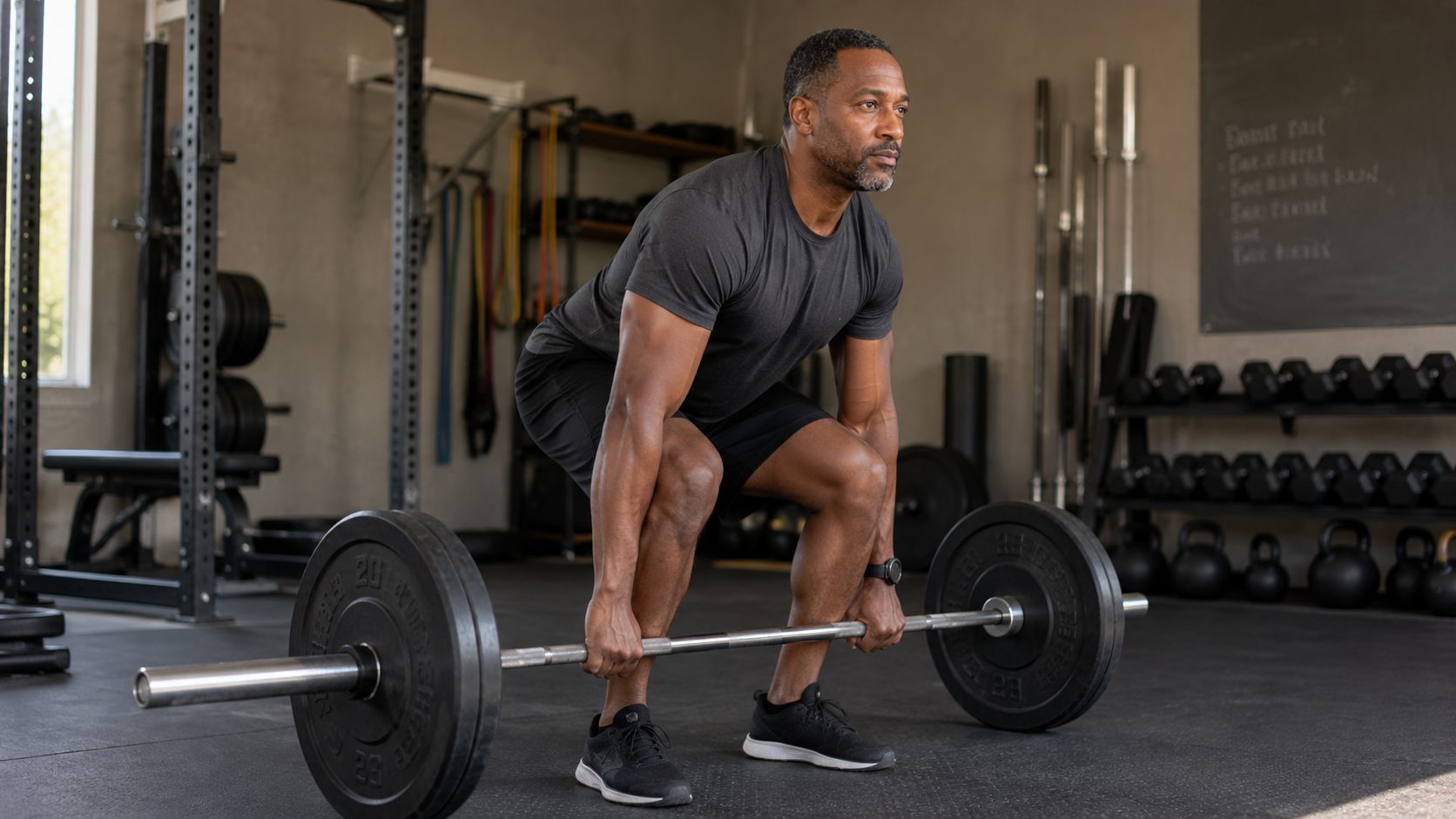
Compound movements do the heavy lifting here: squats, deadlifts or hinges, presses, rows, and carries. Sets taken genuinely close to hard.
Note what this is not for. It is not abdominal work. Training abs will strengthen them under the fat without reducing the fat, because spot reduction is not achievable.
Do thisTwo full-body sessions weekly, 45 minutes each, covering legs, push, pull. Progress the weight or the reps every fortnight. Our guide to the best exercises to lose belly fat has a full weekly structure.
4
Eat more fibre Moderate
The most under-rated item on this list, and the cheapestWhen I compared the pages currently ranking for this topic, fibre appeared on almost none of the men’s lists, despite being one of the better-evidenced items in the whole field.
A five-year observational study tracked people’s fibre intake against how much visceral fat they gained. Every extra 10 grams of soluble fibre a day was linked to 3.7% less visceral fat gained over that period. Add moderate activity on top and that figure rose to 7.4%.[5]
It is observational, so it shows a link rather than proving cause. But 10 grams is not a big ask, and it does something no supplement does: it fills you up on very few calories.
Most UK men fall well short of the 30g daily recommendation. Not because fibre is hard, but because nobody ever told them it mattered.
Do thisPorridge instead of cereal. A tin of beans in the chilli. Leave the skin on the potatoes. Two pieces of fruit a day. That is roughly 10g without buying anything unusual.
5
Fix your sleep, and protect your recovery Moderate
Rule out sleep apnoea, and stop pretending stress is not part of thisShort or broken sleep worsens appetite regulation and insulin sensitivity, and it destroys training consistency more reliably than any other single factor.
There is a male-specific issue here worth taking seriously. Obstructive sleep apnoea is more common in men, strongly associated with central obesity, and frequently goes undiagnosed for years.
It also creates its own loop: apnoea disrupts sleep, poor sleep worsens weight, and additional central fat worsens the apnoea.
Stress belongs in this section rather than its own, and I want to be honest about why.
Search cortisol and belly fat and you will find pages selling supplements to lower it. Visceral fat does carry more cortisol receptors than fat elsewhere, so the mechanism is real. The marketing around it is not.
What stress reliably does is wreck your sleep, push you toward a drink, and eat the time you had for everything else on this list. That indirect route is the one that gets most men, and it is bigger than the hormonal one.
Do thisAim for seven to nine hours. If you snore heavily, wake unrefreshed, or your partner has noticed you stop breathing, see your GP about sleep apnoea. Treating it changes everything downstream. And protect one thing that decompresses you, whether that is a walk without your phone or a fixed finish time.
6
Set a moderate deficit, not an aggressive one Strong
Roughly 0.5 to 1% of body weight per weekMen tend to go hard, get a fast result for three weeks, then abandon it. The aggressive cut is usually the reason, not a lack of discipline.
A steep deficit increases muscle loss, tanks training performance, and rarely survives a busy month at work.
A moderate deficit, often around 500 kcal a day for an average-sized man, is a reasonable starting point. The right figure depends on your size, activity level and health, so treat it as a starting point rather than a prescription. The principle that matters more is the rate: 0.5 to 1% of body weight per week.
Do thisWork out your maintenance calories, subtract around 500, and hold it for eight weeks before judging. My Fitness Tracker calculates this from your own measurements.
7
Add aerobic work you will actually do Strong
150 minutes weekly, and it does not have to be runningUK Chief Medical Officers recommend at least 150 minutes of moderate activity weekly, plus strengthening on two or more days.[8]
In clinic, the word “cardio” makes most men picture running, decide their knees will not take it, and do nothing at all. Brisk walking counts. Cycling counts. Five-a-side counts.
The best form of cardio is the one still happening in March.
Do thisAnchor it to something existing. Walk part of the commute, cycle the school run, or book a weekly game with people who will notice if you do not turn up.
8
Cut liquid calories and ultra-processed food Moderate
The calories that arrive without registeringFizzy drinks, energy drinks, large coffees with syrup, and the meal deal that has become a daily default. None of these deliver much protein, fibre or fullness.
This is not about eliminating takeaways. It is about noticing how much of your weekly intake arrives on autopilot.
Our guide to the best diet to lose belly fat covers the food side properly, including a meal plan you can adapt.
Do thisSwap sugary and energy drinks for water, black coffee or green tea. Keep the food you enjoy; remove the calories you were not tasting anyway.
9
Get your bloods checked Strong
The one almost no man does, and the one that answers the questionOf the men who come to the clinic worried about their middle, very few have had a blood test in the last two years. Central obesity is exactly the situation where one simple panel is worth more than another eight weeks of guessing.
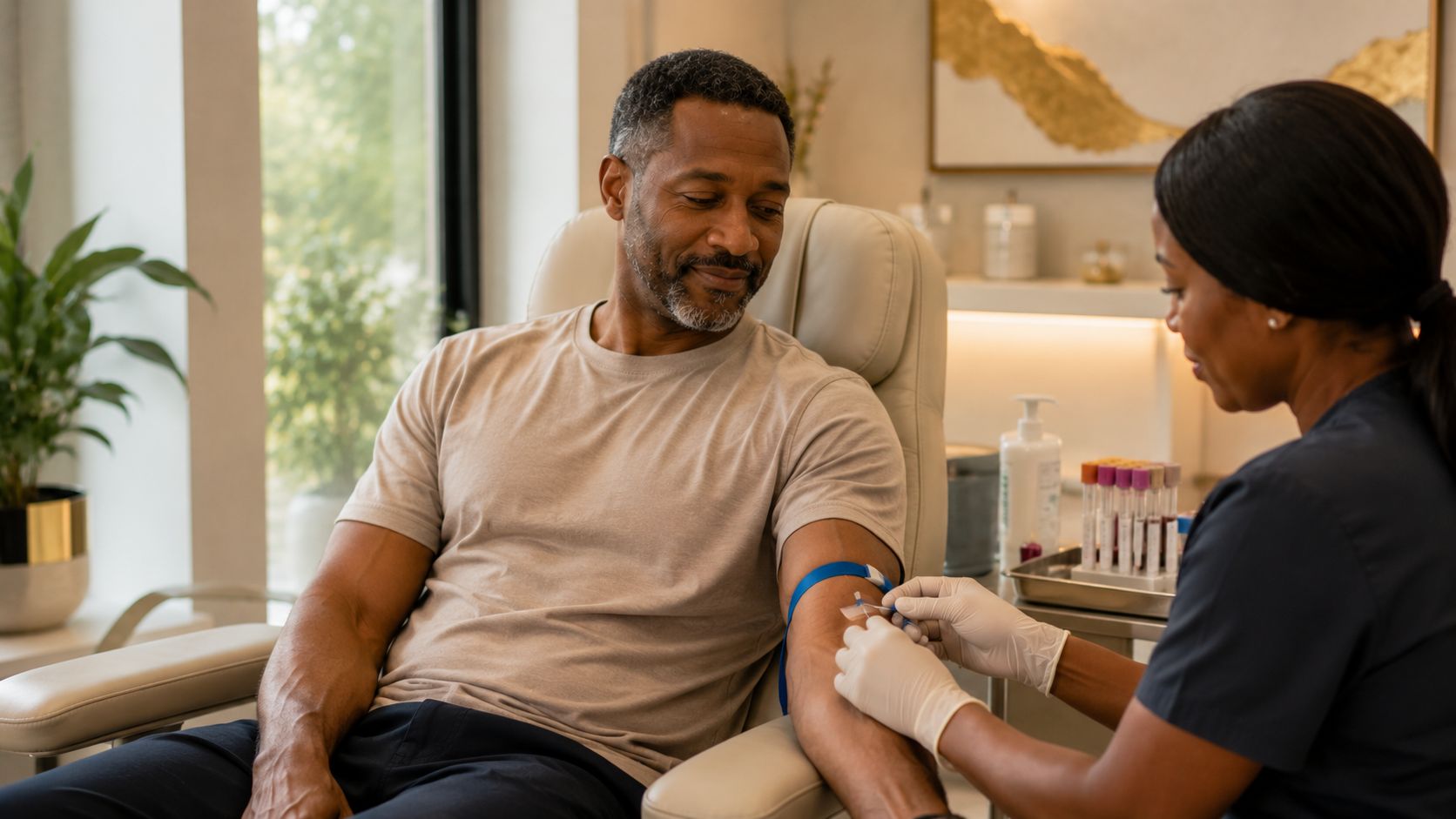
To be precise, because “get your bloods done” is vaguer than it sounds: this means a blood pressure reading, which is not a blood test, plus blood tests that may include HbA1c, lipids and thyroid function, and where symptoms suggest it, morning testosterone.
Which of these is appropriate is your clinician’s call, based on your symptoms and history, not a fixed panel everyone should request.
Worth raising it if you have a high waist measurement, cardiovascular or diabetes risk factors in the family, symptoms of sleep apnoea, sexual symptoms, unexplained weight change, or no progress despite a structured plan.
If you have made genuine changes for three to four months with no measurable waist change, this stops being optional.
And if the foundations really are in place and you are weighing up what is left, non-surgical body contouring is a fair conversation at that point, and only at that point. It works on the fat under the skin, not the deep fat around your organs, so it belongs after the work above rather than instead of it.
Do thisBook with your GP, or arrange preventative health screening if you would rather not wait. Bring your waist measurement and a note of what you have already tried.
Track the number that actually moves
Weight is a poor guide when you are lifting, because muscle and fat move in opposite directions. Our free My Fitness Tracker calculates your calorie and protein targets from your own measurements and tracks waist alongside weight, so you can see the change the scales hide.
Use My Fitness Tracker →What should men eat to lose belly fat?
There is no male-specific diet, and no food that targets the abdomen. What changes is emphasis: more protein than you are probably eating, more fibre than you are definitely eating, and fewer calories arriving in liquid form.
You do not need to give up the food you like. You need to change what most of the plate is made of.
Build meals around these
| Group | Examples | Why it earns a place |
|---|---|---|
| Protein, every meal | Chicken, beef, oily fish, eggs, Greek yoghurt, cottage cheese, tofu | Fullness per calorie, and it protects muscle while you are in a deficit |
| Beans and lentils | Baked beans, chickpeas, red lentils, kidney beans | Protein and fibre in one, and among the cheapest food in the shop |
| Wholegrains | Porridge oats, wholemeal bread, brown rice, wholewheat pasta | More fibre and better fullness than the refined version of the same meal |
| Vegetables, most meals | Frozen mixed veg, salad, tinned tomatoes, spinach | Volume for very few calories. Frozen counts and costs less |
| Fruit | Apples, pears, bananas, frozen berries | Fibre and something sweet that is not a biscuit |
| Unsaturated fats | Olive oil, nuts, avocado, oily fish | Useful for heart health, but calorie-dense, so portion matters |
| Fluids | Water, tea, coffee, sparkling water | Replaces the calories you were drinking without noticing |
Limit these, in this order
First, alcohol. Covered above, and for most men it is the biggest single line on the list.
Second, liquid calories. Fizzy drinks, energy drinks, large coffees with syrup, fruit juice. None of them fill you up.
Third, the daily meal deal. Not takeaways occasionally, the automatic ones. Crisps, pastries and the sandwich you did not choose so much as default to.
Fourth, portion creep and the sauces. Mayonnaise, creamy curries and dressings add up faster than most men expect.
What a normal day looks like
Breakfast: porridge with Greek yoghurt and berries, or eggs on wholemeal toast.
Lunch: chicken or tuna with a jacket potato and salad, or a bean chilli from the batch you made.
Dinner: meat or fish, a wholegrain, and half a plate of vegetables.
If you need it: fruit, nuts, or yoghurt rather than the vending machine.
Nothing exotic. Nothing expensive. Our full guide to the best diet to lose belly fat goes deeper, including a 7-day plan you can adapt.
What does not work
| Approach | Why men try it | What actually happens |
|---|---|---|
| Sit-ups and crunches | Feels targeted at the problem | Strengthens muscle under the fat. Spot reduction is not achievable. |
| Fat burner supplements | Marketed hard to men, promises speed | No supplement targets abdominal fat. Products for men and women are usually the same formula in different packaging. |
| Cutting carbs entirely | Simple rule, fast initial water loss | Often tanks training performance and fibre intake. No advantage over a moderate approach once calories match. |
| Very aggressive deficits | Fast early results | Costs muscle, wrecks training, rarely survives a busy month. |
| Sweat belts and saunas | The scales move immediately | Water loss, returns on rehydration. No fat is metabolised. |
| Training harder while sleeping five hours | Effort feels like the answer | Poor recovery, worse appetite regulation, higher injury risk. |
| Buying testosterone online | Perceived shortcut to the hormonal cause | Unregulated product, can suppress your own production and affect fertility. A GP conversation instead. |
The fat burners marketed to men are, in almost every case, the same formulas sold to women in different packaging. Our evidence review of belly fat burners covers the supplement question in full, including what the UK regulator has and has not approved. The short version: no over-the-counter supplement selectively removes fat from the abdomen, and you should be especially wary of anything promising rapid fat loss, hormone boosting or a detox effect.
A simple 4-week starter plan
Nine things is a lot to start at once. Most men who try fail in week two, not because the advice is wrong but because they changed everything on a Monday.
So here is the same nine, sequenced.
| Week | Add this | Keep doing |
|---|---|---|
| Week 1 | Measure your waist. Cut weekday alcohol. Add a protein source to breakfast. | Nothing else changes yet. No calorie counting. |
| Week 2 | Two full-body resistance sessions. A 20-minute walk on most days. | Week 1 changes. |
| Week 3 | Protein at every meal. Swap refined staples for wholegrain. Fix a bedtime. | Weeks 1–2. |
| Week 4 | Apply a moderate calorie deficit. Remeasure your waist. | Everything above. |
What this looks like for a real person
Take a man of 92kg and 178cm with a 96cm waist. His waist-to-height ratio is 96 divided by 178, which is 0.54, above the 0.5 threshold.
For the next fortnight he changes almost nothing about what he eats. He drops alcohol Monday to Thursday, walks 30 minutes five days a week, does two full-body sessions, puts a protein source in every meal, and measures his waist every Sunday morning before breakfast.
That is it. No tracking app, no meal prep containers, no 5am starts. If his waist has moved by week four, the plan is working and he adds the deficit. If it has not, that is information too.
Notice the calorie deficit arrives in week 4, not week 1. That ordering is deliberate, and it is the opposite of how most men start.
Non-exercise movement, the part nobody counts
If you have a desk job, the 150 minutes of formal exercise matters less than what you do with the other 15 hours you are awake.
- A 10 to 15 minute walk after your main meal
- Take calls standing or walking where you can
- Break up long sitting stretches, even briefly
- Find your current daily step count first, then add to it gradually
For time-poor men, this is often the highest-adherence win available, because it does not require a gym, a change of clothes, or an hour you do not have.
Where weight-loss injections fit in
You have seen the adverts. Half the men I speak to have at least thought about it.
⚠ Where we stand
J Artistry Clinic does not prescribe or supply weight-loss medication. This is not a nudge toward it or away from it. These are prescription-only medicines, and whether one suits you is a decision for a prescriber who knows your history.
Three things I would want a friend to know before he started looking into it.
They do not target your belly. They work on appetite and overall body weight. Same limitation as everything else on this page.
You can lose muscle on them. Fast weight loss from any cause takes muscle along with fat, which means protein and lifting matter more on these drugs, not less. A man who loses three stone and half his muscle has not really won.
The weight tends to come back when you stop, unless the habits underneath are genuinely in place. So the nine things above are not an alternative to medication. They are what makes medication work.
The MHRA has also repeatedly warned about counterfeit and illicitly produced pens sold outside regulated channels. If you go down this road, go through a GP or a properly regulated prescriber, never a seller on social media.
How long it actually takes
A realistic timeline
Weeks 1 to 2: Weight drops faster than fat, mostly water and glycogen, particularly if you have cut alcohol or carbohydrates. Do not read this as your rate of fat loss.
Weeks 3 to 6: The genuine rate emerges, roughly 0.5 to 1% of body weight weekly. Waist starts moving. Sleep and energy usually improve first.
Weeks 6 to 12: Visible change others notice. Visceral fat has typically been reducing since week three, ahead of what the mirror shows.
Month 3 onward: If your waist has not moved at all despite genuine consistency, that is the point to get tested rather than push harder.
Aiming for 0.5 to 1% of body weight per week is the pace that protects muscle. For a 90kg man that is roughly 0.45 to 0.9kg weekly.
Faster is not better here. It just means more of the loss is muscle.
If what you want is visible change, quickly, the honest answer is that the visible part comes last. The internal change happens first, which is fortunately the part that matters most for your health.
To get rid of it for good, the timeline that works is months of moderate consistency rather than weeks of intensity.
When to see your GP
⚠ Book an appointment if any of these apply
- Your waist is 102cm or above, or your waist is more than half your height
- A family history of type 2 diabetes, heart disease or stroke
- Persistent fatigue, low mood, reduced libido or erectile difficulties, which can accompany low testosterone and are worth investigating rather than tolerating
- Heavy snoring, waking unrefreshed, or being told you stop breathing in your sleep
- Excessive thirst, frequent urination or unexplained weight change
- Three to four months of genuine, sustained effort with no measurable waist change
Erectile difficulties in particular are worth raising, because they can be an early marker of cardiovascular problems rather than a standalone issue. It is a short conversation and your GP has had it many times.
What this guide can and cannot tell you
This guide can
- Explain why male fat distribution differs and why it matters
- Give you a waist threshold that actually means something
- Rank the changes by likely return
- Set a realistic timeline so you do not quit at week three
- Tell you which shortcuts are a waste of money
- Tell you when to stop guessing and get tested
This guide cannot
- Diagnose low testosterone or anything else
- Tell you whether TRT is appropriate for you
- Account for your medication or medical history
- Replace your GP, a pharmacist or a dietitian
- Tell you your visceral fat level without imaging
- Promise a result in a specific timeframe
Done the work and the waist has not moved?
That is the point where more effort stops being the answer. Thyroid function, insulin resistance, blood pressure and testosterone are all straightforward to measure, and men are the least likely group to get them checked.
Preventative health screening at J Artistry Clinic gives you the numbers rather than another guess.
J Artistry Clinic · Arches Estate, Spon End, Coventry, CV1 3JQ
Mon to Sat 10am to 8pm · Same-week appointments often available
Prefer to start free? Build a plan with My Fitness Tracker
Mon to Sat 10am to 8pm · Same-week appointments often available
Prefer to start free? Build a plan with My Fitness Tracker
Frequently asked questions
Men lose belly fat the same way anyone does, through a sustained calorie deficit, but the emphasis differs.
Men store proportionally more visceral fat, the deep fat around the organs, which responds relatively well to combined dietary and activity change.
Among the highest-value changes for most men are reducing alcohol, raising protein, resistance training at least twice weekly, and improving sleep.
There is no method that targets the abdomen specifically.
Men typically store fat in an android pattern, meaning centrally around the abdomen, rather than the gynoid pattern of hips and thighs more common in premenopausal women.
This is driven largely by sex hormones.
Importantly, a greater share of male abdominal fat is visceral rather than subcutaneous, which is why two men at the same weight can carry very different metabolic risk.
Visceral fat is metabolically active tissue associated with type 2 diabetes, cardiovascular disease and metabolic syndrome, and men carry proportionally more of it than women at the same BMI.
UK guidance uses waist measurement rather than weight alone for this reason.
A waist of 94cm or above indicates increased risk in men, and 102cm or above indicates high risk, with lower thresholds for men of South Asian, Chinese, other Asian, Middle Eastern, Black African or African-Caribbean family background.
The association is well established and appears to run in both directions.
The association is well established, though the direction of cause is not. A 2026 cross-sectional analysis of 4,948 men from the NHANES survey, of whom 4,492 had valid DXA-derived visceral fat measurements, found visceral fat was strongly and inversely associated with total testosterone, and predicted it better than BMI or waist circumference did.
Because fat tissue converts testosterone to oestradiol, and lower testosterone favours further abdominal storage, the relationship can become self-reinforcing.
These are observational findings, so they show association rather than proving direction of cause.
TRT is not a weight loss treatment and should not be sought for that purpose.
Registry data in hypogonadal men with obesity has reported sustained reductions in weight and waist size on long-term testosterone therapy, but that evidence is observational rather than randomised, and those men had diagnosed hypogonadism.
In the UK, testosterone is prescription-only and requires proper diagnosis, usually including repeat morning blood tests.
Reducing visceral fat through diet and training often raises testosterone without medication.
Not specifically, but alcohol is a genuine and often underestimated contributor.
It provides roughly 7 calories per gram, it is easy to consume in large amounts without feeling full, it disrupts sleep quality, and it suppresses fat oxidation while it is being metabolised.
UK men drink considerably more than UK women on average, which makes this one of the highest-value single changes available to most men.
The fat is not caused by beer specifically, but by the total calories and the disrupted sleep that follow.
Both resistance training and aerobic activity, because they do different jobs.
Resistance training preserves and builds the muscle that raises resting energy expenditure and supports testosterone, while aerobic activity contributes more directly to the calorie deficit.
UK Chief Medical Officers recommend at least 150 minutes of moderate activity weekly plus strengthening activity on two or more days.
Abdominal exercises alone will not reduce abdominal fat, because spot reduction is not achievable.
With a moderate deficit held consistently, measurable waist change typically appears somewhere between weeks 6 and 12, though the rate varies with your starting point, age, sleep and alcohol intake.
Visceral fat tends to respond earlier than subcutaneous fat, which means health markers often improve before the mirror does.
Aiming for roughly 0.5 to 1% of body weight per week is a realistic pace that protects muscle.
No supplement burns fat from the abdomen specifically, and products marketed to men generally contain the same ingredients as those marketed to women, at similar doses, with different packaging.
Only one supplement ingredient holds an authorised weight management health claim in Great Britain, and even that evidence is contested.
Money spent on protein, or on a proper health check, returns considerably more than money spent on a fat burner.
Yes, potentially.
It is possible to have a BMI in the healthy range while carrying enough visceral fat to raise metabolic risk, a pattern sometimes described as normal weight central obesity.
This is why current NICE guidance encourages adults with a BMI under 35 to check waist-to-height ratio, aiming to keep waist below half of height.
If your BMI looks fine but your waist does not, the waist is the more informative measure.
See your GP if your waist is 102cm or above, if you have a family history of type 2 diabetes or heart disease, if you have symptoms such as persistent fatigue, low mood, reduced libido or erectile difficulties which can accompany low testosterone, if you snore heavily or wake unrefreshed which may indicate sleep apnoea, or if sustained effort over three to four months has produced no measurable change.
Blood pressure, HbA1c, lipids and thyroid function are simple tests that provide useful answers.
Intermittent fasting works for some men, but not because of the fasting itself.
Trials that match calorie intake between fasting and non-fasting groups generally find similar fat loss. That points to the benefit coming from eating less overall, not from the clock.
If skipping breakfast makes it easier to hold a deficit without thinking about it, it is a reasonable tool. If it leaves you ravenous by evening and eating more than you otherwise would, it is working against you.
It also makes hitting a protein target harder, which matters if you are trying to protect muscle.
Related reading
References
Every figure has been checked against the original publication. Study type and key limitations are stated so you can weigh the evidence yourself.
- Low testosterone is a phenotype of visceral adiposity. Journal of the Endocrine Society, 2026;10(8). Cross-sectional analysis of 4,948 US men aged 20–59 from NHANES 2011–2016, with 4,492 valid DXA-derived visceral fat measures. Visceral adiposity was strongly and inversely associated with total testosterone, and predicted it better than BMI or waist circumference. Observational; the authors note the design precludes causal inference. academic.oup.com/jes
- Saad F, Yassin A, Doros G, Haider A. Effects of long-term treatment with testosterone on weight and waist size in 411 hypogonadal men with obesity classes I–III: observational data from two registry studies. International Journal of Obesity. Observational registry data, not a randomised trial. Participants had diagnosed hypogonadism. ncbi.nlm.nih.gov/pmc/PMC4722240
- National Institute for Health and Care Excellence (NICE). Overweight and obesity management (NG246). Published January 2025. Clinical guideline. Replaces CG189. Encourages self-measured waist-to-height ratio in adults with BMI under 35, with 0.5 or above indicating increased risk, and sets lower thresholds for several ethnic groups. nice.org.uk/guidance/ng246
- NHS England Digital. Health Survey for England 2024: Adults’ health-related behaviours. Published January 2026. National survey. 27% of men drank over 14 units weekly versus 15% of women; mean typical weekly intake 14.7 units for men and 8.5 for women. digital.nhs.uk/health-survey-for-england/2024
- Hairston KG, Vitolins MZ, Norris JM, et al. Lifestyle factors and 5-year abdominal fat accumulation in a minority cohort: the IRAS Family Study. Obesity, 2012;20(2):421–427. Observational cohort, 5-year follow-up, visceral fat measured by CT. Each additional 10g of soluble fibre daily was associated with 3.7% less visceral fat gained. Association only; causation not established. pubmed.ncbi.nlm.nih.gov/21681224
- NHS. How to get more fibre into your diet. National guidance. 30g daily recommendation for adults. nhs.uk/live-well/eat-well
- Medicines and Healthcare products Regulatory Agency (MHRA). Warnings on falsified weight-loss pens sold outside regulated channels. Regulatory safety guidance. gov.uk/mhra
- UK Chief Medical Officers. Physical activity guidelines for adults aged 19 to 64. Via NHS. National guidance. At least 150 minutes of moderate activity weekly plus strengthening on two or more days. nhs.uk/live-well/exercise
- NHS. Alcohol units. National guidance. No more than 14 units weekly, spread over three or more days. nhs.uk/live-well/alcohol-advice
- NHS. Sleep apnoea. National patient guidance. Commonly underdiagnosed and associated with central obesity. nhs.uk/conditions/sleep-apnoea
- NHS. Erectile dysfunction. National guidance. Notes that erectile dysfunction can be an early sign of cardiovascular disease and warrants assessment. nhs.uk/conditions/erection-problems
- NHS. Type 2 diabetes. National guidance covering risk factors and testing. nhs.uk/conditions/type-2-diabetes
Corrections and editorial policy. Every statistic was checked against the original published paper before publication on 2 September 2026, and study type and limitations are stated openly. If you spot an error, contact info@jartistryclinic.com. J Artistry Clinic provides paid clinical services; this article is educational and its guidance does not require any purchase. See our full medical disclaimer.