
Book Appointment

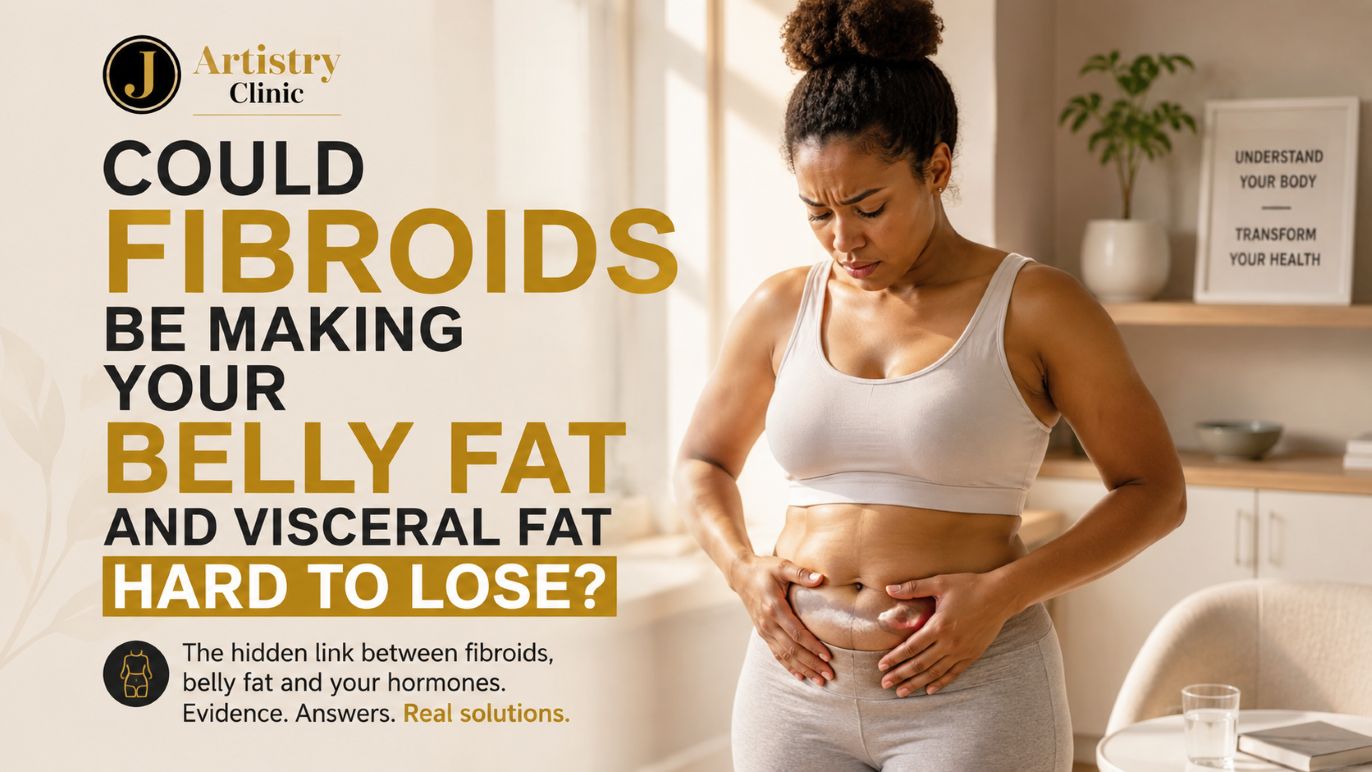
Could Fibroids Be Making Your Belly Fat and Visceral Fat Hard to Lose?
You are doing everything right.
You have changed what you eat, you are exercising, you have cut back on alcohol, and you are sleeping better.
And your belly fat still looks exactly the same.
Not only that, it feels different to the rest of your body. Firmer. Lower down. Rounder in a way that does not shift even on your best weeks.
You have probably been told to try harder. Eat less. Move more.
But what if the reason your belly is not responding has nothing at all to do with how hard you are trying?
What if the belly you are working to lose is not entirely fat, and that is exactly why nothing has worked?
I am Joanna Karto, founder of J Artistry Clinic in Coventry, and an NHS-trained healthcare practitioner with five years of clinical experience.
In those five years, fibroids are one of the most consistently missed explanations I come across. Women arrive having been told to try harder, when the problem was never fat in the first place.
I see this pattern often enough that I wanted to write the guide I wish more women were given years earlier, covering uterine fibroids, visceral fat, the hormonal link between them, and what can actually be done.
Please read this before you spend another month trying to lose a belly that may not be responding for reasons entirely outside your diet and training.

Written by
Joanna Karto
Founder & Healthcare Practitioner · J Artistry Clinic, Spon End, Coventry
NHS-Trained · VTCT Accredited · 5 Yrs Clinical Experience
Published 20 July 2026 · Reviewed and updated 8 October 2026 · Every figure checked against the original paper · Next review: January 2027 · 20 min read
⭐ 4.8 / 5 · based on verified client reviews
📋 What This Guide Covers
- The three types of belly women confuse
- Visceral fat versus subcutaneous fat, explained
- What fibroids actually are
- How fibroids create the appearance of belly fat
- The hormonal and metabolic links
- Not fibroids? Other causes of resistant belly fat
- How to tell if your belly may be fibroid-related
- What responds, and what does not
- The UK reality: waiting lists and inequity
- Fibroid treatment options in the UK
- What J Artistry Clinic can and cannot offer
- Your practical action plan
- When to see your GP, and what to say
- What this article can and cannot tell you
- Frequently asked questions
Medical disclaimer and scope. This article is an educational resource written by an NHS-trained healthcare practitioner. It is not a diagnosis and does not replace care from a GP or gynaecologist.
J Artistry Clinic does not diagnose or treat uterine fibroids. Fibroids are a medical condition requiring GP assessment, pelvic ultrasound and gynaecological care. This article explains the physiological context so you understand what may be happening and what to ask your doctor. Read our full medical disclaimer.
The 30-Second Answer
Could fibroids be making your belly fat hard to lose?
Possibly, yes. Fibroids do not create belly fat, but they enlarge the uterus, which pushes the lower abdomen outward and looks almost identical to stubborn belly fat. No diet or exercise reduces that, because it is not fat.
Separately, the hormonal environment associated with fibroid growth is also associated with visceral fat, the deep abdominal fat around your organs. So many women have both at once, from the same underlying cause.
If your lower belly fat has not moved in three months while the rest of your body has responded, and you also have heavy periods or pelvic pressure, ask your GP for a pelvic ultrasound before spending another month on the gym.
Firm, low, will not shift
Heavy or painful periods
Pelvic pressure
Ask for: pelvic ultrasound
Think something may be driving your belly that diet and exercise cannot fix? A clinical assessment can help you understand what is actually happening and what the right next step is.

The three types of belly women confuse
📊 Quick summary
When women describe belly fat, they are usually describing one of three different things, each with a different cause and a different solution.
Treating the wrong one produces no result at all, which is why identifying which you are dealing with comes before any treatment decision.
Most articles about abdominal fat treat it as a single thing. It is not.
Subcutaneous Fat
The soft, pinchable layer
Sits directly under the skin. Soft, and you can pinch it between your fingers. Spreads across the abdomen generally rather than sitting in one spot.
✓ Responds to: sustained diet and exercise, and body contouringVisceral Fat
The deep internal layer
Wraps around the organs deep inside the abdomen. Cannot be pinched, and cannot be reliably identified by touch or appearance. Linked to hormones and stress.
✓ Responds to: sustained lifestyle change and hormonal investigationFibroid Distension
Not fat at all
The uterus itself physically enlarged by fibroids. Can look identical to fat from the outside. Usually firm, and usually low in the abdomen.
✕ Does not respond to: diet, exercise or any fat reduction treatmentMany women have all three at once, which is precisely why progress feels so confusing.
You can genuinely reduce your subcutaneous fat, see your arms and legs change, and still see almost no difference in your lower abdomen, because two of the three components are not responding to what you are doing.
Four things that look like belly fat, side by side
Bloating belongs in this comparison too, because it is confused with belly fat more often than anything else on this list.
| Subcutaneous fat | Visceral fat | Fibroid enlargement | Bloating | |
|---|---|---|---|---|
| Where it sits | Under the skin, across the abdomen | Deep inside, around the organs | Usually lower abdomen | Varies, often whole abdomen |
| How it feels | Soft and pinchable | Cannot be reliably assessed by touch | May feel firm, but not diagnostic | Tight, sometimes uncomfortable |
| Changes within a day | No | No | No | Yes, often worse by evening |
| Responds to weight loss | Yes, gradually | Yes, often earlier than subcutaneous | No | Only if diet is the cause |
| Linked to your cycle | No | No | Symptoms may fluctuate | Often |
| How it is assessed | Body composition, waist measurement | Imaging (MRI, CT, DXA) | Ultrasound, sometimes MRI | Clinical assessment |
If your abdomen is noticeably flatter in the morning and distended by evening, that pattern points toward bloating rather than fat or fibroids, and no amount of calorie restriction will address it.
Still unsure which of the four applies to you? That is exactly what a clinical assessment is for, and it takes one conversation rather than another three months of guessing.
Visceral fat versus subcutaneous fat, explained properly
Because this distinction matters so much for the rest of this guide, it is worth being precise about it.
Subcutaneous fat is the layer directly beneath your skin. It is what you pinch. It is largely a storage tissue, and while it affects how you look, it is far less strongly linked to disease risk.
Visceral fat, sometimes called internal fat or visceral belly fat, sits deeper, packed around the liver, pancreas and intestines. You cannot pinch it.
An important caveat here, because a great deal of online content gets this wrong: you cannot reliably tell how much visceral fat you have by pressing your stomach.
A firmer abdomen is sometimes mentioned as a sign, but firmness also reflects muscle tone, posture, bloating and the uterus itself. Visceral fat is internal, and only imaging measures it.
The difference matters clinically. Visceral fat is metabolically active tissue that releases inflammatory signals and free fatty acids directly into the portal circulation, which is why it is far more strongly associated with type 2 diabetes, cardiovascular disease and metabolic syndrome than subcutaneous fat is.[1]
📏 About visceral fat level and visceral fat rating
Many home body composition scales display a visceral fat level or visceral fat rating, usually a number between 1 and 59.
These use bioelectrical impedance, which estimates rather than measures. They are reasonable for tracking a trend in yourself over time, but they are not accurate enough to diagnose anything, and readings vary with hydration, food and time of day.
Only MRI, CT or DXA imaging measures visceral fat directly. For home use, a tape measure around your waist, used consistently, is at least as informative as the number on the scale.
For most people, the practical marker is waist circumference, and ideally a waist that measures less than half your height, which is the threshold NICE guidance supports alongside BMI.[2]
If you want the complete picture of what drives abdominal fat and what reduces it, our main guide covers the best way to lose belly fat in full.
On the practical side, our companion guides cover the best diet to lose belly fat and the best exercises to lose belly fat, both chosen specifically for their effect on visceral fat rather than general weight loss.
What fibroids actually are
📊 Quick summary
Uterine fibroids are non-cancerous growths of muscle and fibrous tissue that develop in or on the wall of the uterus.
They range from the size of a pea to larger than a melon, and they are extremely common. They are benign, but a large fibroid can distend the abdomen enough to look exactly like persistent belly fat.
Fibroids are not rare or unusual. The NHS describes them as non-cancerous growths that develop in or around the womb.[3]
They are made of smooth muscle and fibrous tissue, and importantly they are benign, meaning not cancerous. A 2025 review in the International Journal of Gynecology & Obstetrics notes that fibroids cannot be reliably diagnosed by physical examination, and that their impact cannot be predicted by palpation, which is why imaging is central to assessment.[5]
You will see wildly different numbers quoted for how common fibroids are, and it is worth understanding why, because the gap is not an error.
It depends entirely on how they are counted.
📊 Why prevalence figures disagree so much
Ultrasound screening studies, which scan women regardless of symptoms, report cumulative incidence by age 50 of up to around 70% in white women and over 80% in Black women.[4]
Self-report surveys in the UK find far lower figures, around 4.5% of women of reproductive age, because most women with fibroids have never been scanned and do not know.[6]
Both are accurate. They are measuring different things: how many women have fibroids, versus how many women know they have fibroids.
The practical takeaway is that fibroids are common, most cause no symptoms, and a meaningful number of women who do have symptoms have never been investigated.
But some grow large enough to expand the uterus from roughly the size of a pear to the size of a melon or beyond.
When the uterus expands, the abdomen expands with it, and no amount of dieting changes that.
~70–80%
cumulative incidence by age 50 in ultrasound screening studies
19.8%
of Black women in the UK report fibroids, versus 5% of white women
743,312
women on UK gynaecology waiting lists (all conditions), December 2025
How fibroids create the appearance of belly fat
Here is exactly what happens.
A healthy uterus weighs roughly 60 to 90 grams and sits low in the pelvis.
A uterus enlarged by fibroids can weigh a great deal more. Even an increase to one or two kilograms, which is not unusual in symptomatic fibroids, creates a very visible change to the lower abdomen.
As the uterus expands, it pushes upward and outward against the abdominal wall, creating a rounded protrusion below the navel, sometimes reaching above it in larger cases.
That protrusion is firm to the touch. It does not move the way belly flab moves. It may feel more tender or pronounced around your period.
And it does not respond to diet, to exercise, or to any non-surgical body contouring treatment.
Women who have worked genuinely hard, achieved real changes in body composition everywhere else, and still see nothing change in this one area are frequently dealing with exactly this.
⚠ Why this matters before you spend money
This is the single most important practical point in this guide.
If your abdomen is distended by fibroids and you book a course of fat freezing or cavitation, you will not get the result you paid for, because those treatments act on fat cells and fibroids are not fat.
Establishing what you are actually dealing with should always come before any treatment is booked.
The hormonal and metabolic links between fibroids and visceral fat
🧬 The hormonal connection
This is the part most conventional belly fat advice misses entirely.
Fibroids and visceral fat share overlapping influences, including sex-hormone signalling and metabolic factors. That is a more careful statement than the version you will read elsewhere, and it is deliberately so.
Fibroids are hormone-dependent growths. They contain more oestrogen and progesterone receptors than normal uterine tissue, which is why they typically grow during the reproductive years and often shrink after the menopause when oestrogen falls.
A large UK cohort adds useful context here. The Million Women Study followed 610,604 postmenopausal women and examined how body mass index and hormone therapy related to subsequent fibroid diagnosis, finding associations with both.[7]
Fat tissue is not passive either. It contains an enzyme called aromatase, which converts other hormones into oestrogen, meaning more fat tissue generally means more circulating oestrogen.
That creates the possibility of a reinforcing loop.
The proposed oestrogen, fibroid and visceral fat loop
Starting pointHigher or imbalanced oestrogen exposure
↓
Path AFibroids grow, the uterus enlarges, and the lower abdomen protrudes
+
Path BFat distribution shifts abdominally and visceral fat accumulates
↓
The loop closesVisceral fat tissue produces additional oestrogen and inflammatory signals, which may further support fibroid growth
This model is plausible and supported by association, not proven cause and effect. The studies below are observational, and reverse causation cannot be excluded.
What the evidence actually shows Moderate evidence
A 2019 case-control study compared 89 women with fibroids against 81 women without, and found that those with a higher visceral fat area had around four times the odds of having fibroids, with an odds ratio of 3.91 and a confidence interval of 2.03 to 7.54.[8]
🔍 How to read that study honestly
It is a genuinely interesting finding, but it deserves proper caveats.
The study was small, with 170 women in total, conducted at a single hospital in China, and it used bioelectrical impedance rather than imaging to estimate visceral fat.
Critically, it is case-control, which means it shows an association at one point in time. It cannot tell us whether visceral fat contributed to the fibroids, whether the shared hormonal environment produced both, or whether something else explains it.
Treat it as a meaningful signal that fits the biology, not as proof.
Stronger support comes from a 2021 systematic review and meta-analysis of 22 studies, which found obesity is associated with increased fibroid risk, though notably in a non-linear pattern rather than a simple straight line.[9]
Alongside this, the British Menopause Society notes that as oestrogen declines through the menopause, visceral fat rises from around 5 to 8% of total body weight to approximately 10 to 15%, confirming that oestrogen strongly influences where women store fat.[10]
What this means practically is straightforward.
You are not failing to try hard enough. You may be working against a hormonal environment that is influencing two things at once, and only one of them responds to the gym.
Track your waist properly while you wait for answers
Waist circumference tells you far more about visceral fat than the bathroom scale does, but only if you measure it consistently. Our free My Fitness Tracker logs your waist and weight over time and shows you the trend rather than the daily noise.
Use My Fitness Tracker →Not fibroids? Other causes of resistant belly fat
📊 Quick summary
Fibroids are one of the more commonly missed causes of stubborn belly fat in women, but they are not the only one.
Perimenopause, PCOS and chronic stress each produce their own version of the same frustrating pattern.
🧬 Perimenopause
Perimenopause typically begins in the early to mid forties, and oestrogen does not decline smoothly. It fluctuates, often dramatically, before settling lower.
During that transition, fat distribution shifts abdominally, which is why women describe a hormonal belly appearing despite no change in diet. Our guide to losing belly fat in women covers this life stage in detail.
🧬 PCOS
PCOS affects at least 1 in 10 women in the UK and disproportionately affects Black and South Asian women.[11] It drives abdominal fat storage through elevated androgens and insulin resistance.
If you have irregular periods, acne, excess facial hair or fertility difficulties alongside resistant abdominal fat, the NHS PCOS guidance sets out the diagnostic criteria worth discussing with your GP.
🧬 Chronic stress and cortisol
Sustained stress maintains elevated cortisol, and visceral fat cells carry a higher density of cortisol receptors than fat elsewhere in the body.
This type of visceral belly fat can be unusually resistant to high-intensity exercise, because intense training itself raises cortisol. It often responds better to moderate activity paired with genuine stress reduction and adequate sleep.
These can all coexist, both with each other and with fibroids, which is exactly why assessment rather than guesswork produces the most useful picture.
Because diet remains the largest single lever regardless of which of these applies to you, our evidence-based diet guide is a sensible place to start while you wait for answers, and our overview of what J Artistry Clinic does explains the wider support available.
How to tell if your belly may be fibroid-related
⚠ This is not a diagnostic tool
Fibroids cannot be self-diagnosed. They cannot even be reliably diagnosed by a doctor on physical examination alone, which is why imaging exists.[5]
What this checklist does is help you recognise a pattern worth investigating, and give you specific language for your GP appointment.
☑ Could your belly be fibroid-related?
Tick anything that applies to you. Nothing is stored or sent anywhere, and this runs entirely in your browser.
Tick the boxes above to see what they suggest
Whatever the result, this is a prompt for a conversation, never a diagnosis.
May be fibroid-related if you notice these
- →A firm, rounded lower-abdominal protrusion you cannot pinch as soft fat
- →It sits below the navel, sometimes more prominent on one side
- →Three or more months of consistent effort has changed the rest of your body but not this
- →It feels fuller around your period and slightly less so between periods
- →Your periods have become heavier, longer or more painful over recent years
- →Pelvic pressure, a sense of fullness, or needing to urinate more often
- →Lower back or hip pain without a musculoskeletal explanation
- →Anaemia, or fatigue that tracks with your menstrual cycle
More likely to be subcutaneous or visceral fat if
- ✓It is soft and pinchable, with no firm immovable core
- ✓It spreads across the upper and lower abdomen rather than sitting low and distinct
- ✓Your periods are unchanged in flow and duration
- ✓No pelvic pressure, urinary urgency or significant period pain
- ✓It does respond to sustained effort, even if frustratingly slowly
🧬 A note on mixed presentations
Many women have both fibroids and genuine fat contributing to what they see in the mirror.
This is exactly why clinical assessment matters more than self-categorisation. You may have a fibroid component and a fat component that each need a different response, in a particular order.
What responds, and what does not
What diet, exercise and treatment can change
- Subcutaneous fat, gradually, with sustained effort
- Visceral fat, with lifestyle change, stress management and hormonal support
- Fibroid distension, but only after medical fibroid treatment
- Residual fat after fibroid treatment, where body contouring becomes appropriate
- Bloating from diet, gut issues or fluid retention
What cannot change fibroid distension
- Calorie restriction or any specific diet
- Exercise of any type or intensity
- Cryolipolysis, which targets subcutaneous fat cells only
- Ultrasound cavitation
- EMS body sculpting
- Any non-surgical body contouring, since all of it acts on fat
⚠ Before booking any body contouring treatment
Any responsible clinic should establish whether your abdominal concern is fat-related before applying any treatment.
At J Artistry Clinic, clinical assessment always precedes any body contouring recommendation. If assessment raises concern about fibroids, we will direct you to your GP before any treatment is discussed or booked.
If a clinic offers to treat your abdomen without asking about your periods, pelvic symptoms or history, that is a reason to pause.
Not sure what is driving your belly? A clinical assessment can tell you whether a GP referral, health screening, body contouring, or a combination is the right next step.
The UK reality: waiting lists and inequity
🏥 What the current data shows
According to RCOG data published in January 2026, 743,312 women were on UK gynaecology waiting lists as of December 2025, a fall of only 3% since November 2024.[12]
Gynaecology now has the fifth largest waiting list of any elective specialty in the UK, and is the only specialty that solely concerns women’s health.
RCOG reports that waiting lists have risen most sharply among women from Black and Asian backgrounds, and that incomplete ethnicity data may mean the true scale is underestimated.[12]
Written evidence submitted to Parliament by the NHS Race and Health Observatory records that 19.8% of Black women report having fibroids, compared with 5% of their white counterparts.[11]
RCOG’s own position, published in January 2026, is unambiguous: Black women are more likely to develop fibroids, experience more severe symptoms, and face longer delays in diagnosis and treatment.[13]
This matters for this guide because it means something specific.
If you are a woman with persistent abdominal changes and gynaecological symptoms who has never been investigated, that may not be because you failed to seek help. It may be because the system did not investigate promptly.
What you can do about it:
See your GP and ask specifically for a pelvic ultrasound. Use those words. Describe your symptoms in detail, and bring a written list so nothing is forgotten in a short appointment.
If you are dismissed without investigation, you are entitled to ask again, request a second GP opinion, or request a gynaecology referral directly.
A private diagnostic pelvic ultrasound can usually be arranged within one to two weeks if NHS waiting times are not workable for your situation.

Fibroid treatment options in the UK
📊 Quick summary
If fibroids are confirmed, several treatment routes exist, from medication to minimally invasive procedures to surgery.
The right choice depends on fibroid size, number and position, your symptoms, your age, and whether you want to preserve fertility. This is a reference for what to ask about, not a recommendation.
Medication
GnRH agonists temporarily reduce oestrogen, which can shrink fibroids and reduce bleeding. This is not a cure, since fibroids may regrow after treatment stops, but it can control symptoms or shrink fibroids before surgery. Tranexamic acid and hormonal treatments can reduce heavy bleeding without shrinking the fibroid itself.
Uterine artery embolisation
A radiologist passes a fine tube through an artery and injects particles that block the blood supply feeding the fibroids, which then shrink. The uterus is preserved and recovery is typically one to two weeks. It is available on the NHS, though not at every hospital, so referral to a specialist centre may be needed. See the NHS fibroid treatment guidance for the current overview.[14]
Myomectomy
Surgical removal of the fibroids while leaving the uterus intact, which makes it the usual preference where fertility matters. It can be open, laparoscopic, or hysteroscopic depending on fibroid position. Fibroids can recur afterwards, which is a known limitation.
Hysterectomy
Removal of the uterus, and the only treatment that guarantees fibroids cannot return. Appropriate where symptoms are severe, family is complete, and other options have not worked. You will no longer have periods and cannot become pregnant afterwards.
MRI-guided focused ultrasound
Focused ultrasound destroys fibroid tissue without incisions, performed inside an MRI scanner. Available at a limited number of UK specialist centres rather than widely on the NHS.
Monitoring without treatment
Where fibroids are confirmed small and asymptomatic, and particularly if you are approaching menopause, monitoring can be entirely appropriate. The distinction that matters is that this should be an active decision made with your doctor, not a default because treatment was hard to access.
Further reading: RCOG patient information leaflet on uterine fibroids and NICE guidance NG88 on heavy menstrual bleeding, which covers fibroid management.[15,16]
What J Artistry Clinic can and cannot offer
💬 From Joanna, being direct about our role
I want to be completely clear here, because clarity matters more than selling anything.
We do not diagnose or treat fibroids. If someone comes to me with symptoms suggesting fibroids, the first thing I say is to see their GP, before we discuss anything else.
What we can genuinely help with is what comes before and after the medical pathway.
What we can offer
Clinical assessment. Helping you understand whether your concern is likely fat-related, possibly fibroid-related, or a combination, and what the appropriate next step is for each. This is a clinical perspective to inform your GP conversation, not a diagnosis.
Preventative health screening. Biomarker testing covering thyroid function, iron status and metabolic markers gives useful context to bring to your GP.
To be explicit, because it matters: this cannot diagnose fibroids, and it is not an alternative to a scan. If fibroids are suspected, imaging is what you need, and I will say so.
Post-treatment body contouring. For women who have completed fibroid treatment and have genuine residual fat once distension has resolved, body transformation treatments are appropriate and effective. This is precisely the right context for them.
Post-surgical recovery support. Lymphatic drainage after myomectomy or hysterectomy supports swelling management and healing. Our guide to post-operative care after surgery covers what recovery involves, and our recovery therapy service supports clients after gynaecological surgery.
Honest signposting. If assessment raises concern about an uninvestigated issue, I will tell you directly and recommend the medical pathway, including what to say to your GP.
What we cannot offer
We cannot diagnose fibroids, shrink or remove them, or prescribe fibroid medication. Body contouring here is for subcutaneous and visceral fat, not fibroid distension, and we will not treat an abdomen where fibroids are suspected but uninvestigated.
Your practical action plan
1
Work through the checklist and write it down
Go back to the symptom section above and note honestly which items apply to you. That written list becomes what you tell your GP, and it removes the risk of forgetting things under pressure in a ten-minute appointment.
2
Book the GP appointment this week
Not once you have lost some weight first. That instinct to wait is extremely common and it is exactly what turns a short delay into a multi-year one. Your body is telling you something, and the right response is to investigate it.
3
Use specific language
Say: “I would like to request a pelvic ultrasound. I have [your symptoms]. I am concerned about uterine fibroids.” If you are told it is just bloating or to try losing weight, respond: “I understand, but I would still like a pelvic ultrasound to rule out fibroids. Can you refer me, please?”
4
If you want additional health information while you wait
Blood tests cannot confirm or rule out fibroids. Imaging is required for that. Please do not treat screening as a substitute for the scan.
What preventative health screening can do is give you information on thyroid function, markers relevant to insulin resistance, and iron levels, which is genuinely useful if heavy periods have left you anaemic, and useful context to bring to a GP appointment.
5
If dismissed, escalate
Ask for a second GP opinion or a direct gynaecology referral. Fibroid Network UK offers patient support and advocacy guidance. A private pelvic ultrasound is also an option and does not require a GP referral.
6
After treatment, address what remains
Once fibroids have been treated, distension typically resolves over the following months. What remains is genuine fat, and that is the point at which body contouring, lymphatic drainage and targeted lifestyle work become effective. Contact us at that stage rather than before.
📏 Not sure whether your waist is actually changing? Track it consistently and see the trend with My Fitness Tracker, free from J Artistry Clinic.
When to see your GP, and what to say
⚠ See your GP without delay if you have
- A firm lower-abdominal protrusion that has not reduced despite genuine sustained effort
- Periods that have become significantly heavier, longer or more painful over recent years
- New or worsening pelvic pressure, fullness or urinary urgency
- Unexplained anaemia or fatigue that tracks with your cycle
- An abdomen that looks larger around your period and smaller between periods
- Any of the above alongside a belly unresponsive to changes that worked elsewhere on your body
Seek urgent medical advice if you have severe pelvic pain, very heavy bleeding with dizziness or breathlessness, or sudden abdominal swelling with pain, as these need same-day assessment.
What to say: “I would like to request a pelvic ultrasound. I have [your symptoms]. I am concerned that fibroids may be a factor.” Using the words pelvic ultrasound and fibroids, and describing symptoms specifically, increases the likelihood of appropriate investigation.
What this article can and cannot tell you
Being explicit about the limits of an article like this matters more on a health topic than on any other.
This article can help you
- Understand why an abdomen enlarges, and the different reasons it happens
- Tell the difference between visceral fat and subcutaneous fat conceptually
- Recognise a symptom pattern that is worth investigating
- Know which questions to ask, and what language helps
- Understand what treatments exist and what each does
- Know when body contouring is and is not appropriate
This article cannot
- Diagnose fibroids, or rule them out
- Tell you your visceral fat level
- Tell you whether a specific lump is a fibroid
- Replace a GP or gynaecological assessment
- Predict how you will respond to any treatment
- Substitute for imaging where fibroids are suspected
If you take one thing from this guide, let it be that persistent abdominal change that does not respond to genuine effort deserves investigation, not another three months of trying harder.
Frequently asked questions
The questions women search most often about fibroids, belly fat and visceral fat.
Fibroids do not directly create belly fat, meaning the actual subcutaneous or visceral fat layers. They do make the abdomen look and feel larger in two ways.
First, larger fibroids physically enlarge the uterus and push the lower abdomen outward, which closely mimics belly fat. Second, the hormonal environment associated with fibroid growth, primarily oestrogen, is also associated with abdominal fat distribution.
Many women therefore have both fibroid-related distension and genuine visceral fat at the same time.
There are two possible reasons and many women have both.
If your abdomen is distended mainly by fibroids, no amount of diet, exercise or body contouring will reduce it, because you are trying to shrink something that is not fat.
If you also carry genuine visceral fat, the hormonal environment associated with fibroids is also associated with abdominal fat storage, which can make that fat more stubborn than it would otherwise be. Investigating the fibroids usually needs to come first.
Fibroid-related distension is usually in the lower abdomen below the navel, often feels firmer and denser than fat when pressed, does not respond to diet and exercise, and may fluctuate around your menstrual cycle.
It is frequently accompanied by heavy, prolonged or painful periods, pelvic pressure, frequent urination or lower back pain.
Subcutaneous fat is soft, pinchable and does gradually respond to sustained lifestyle change. Only a pelvic ultrasound can confirm fibroids, which your GP can refer you for.
Subcutaneous fat sits directly beneath the skin and is the soft layer you can pinch. Visceral fat sits deeper in the abdominal cavity, surrounding the internal organs, and cannot be pinched.
Visceral fat is the more metabolically active of the two and is more strongly associated with cardiovascular disease and type 2 diabetes.
A firm rather than soft abdomen often indicates a higher proportion of visceral fat, although only imaging such as MRI, CT or DXA can measure it directly.
The evidence suggests the relationship runs in both directions, though it is associative rather than proven causal.
A 2019 case-control study of 170 women found those with higher visceral fat area had around four times the odds of uterine fibroids, with an odds ratio of 3.91. That study was small and single-centre, so it should be read as a signal rather than proof.
A larger 2021 systematic review and meta-analysis found obesity is associated with increased fibroid risk in a non-linear pattern. Visceral fat is hormonally active tissue, which offers a plausible mechanism.
It typically presents as a firm, rounded protrusion in the lower abdomen that does not soften significantly when pressed. Larger fibroids can make the abdomen look pregnant.
Distension is usually fairly symmetrical but may be more prominent on one side depending on fibroid position.
Unlike bloating, it does not resolve overnight, and unlike fat, it does not gradually reduce with sustained dieting. Some women notice it feels more pronounced around their period.
Reducing visceral fat may modestly reduce hormonal signals associated with fibroid growth, since fat tissue produces oestrogen.
However, weight loss will not shrink existing fibroids or resolve fibroid-related distension. If the abdominal change is primarily fibroid-related, medical or surgical treatment is what reduces it.
Weight management is a supportive measure for overall health, not a fibroid treatment.
No. Cryolipolysis, ultrasound cavitation and EMS body sculpting all act on subcutaneous fat cells. They have no effect on uterine fibroids, which are growths of muscle and fibrous tissue within the wall of the uterus.
Applying body contouring to an abdomen distended by fibroids will not reduce the distension.
Any responsible clinic should establish whether the concern is fat-related before recommending body contouring, and decline to treat where fibroids are suspected but uninvestigated.
Fibroids often shrink and become less symptomatic after the menopause, when oestrogen levels fall. During the reproductive years they rarely disappear on their own.
Some small fibroids remain stable for years, while others grow, particularly during pregnancy.
Monitoring without treatment is reasonable where fibroids have been confirmed as small and asymptomatic, as an active decision made with your doctor. Waiting without any investigation, when you have symptoms, is not the same thing and is not advisable.
Waiting times are currently a serious problem. According to RCOG data published in January 2026, 743,312 women were on gynaecology waiting lists in the UK as of December 2025, a fall of only 3% since November 2024.
Gynaecology has the fifth largest waiting list of any elective specialty.
RCOG has also warned that waiting lists have risen most sharply among women from Black and Asian backgrounds, and that Black women face longer delays for fibroid diagnosis and treatment specifically.
After successful fibroid treatment, whether medication, uterine artery embolisation, myomectomy or hysterectomy, fibroid-related abdominal distension typically reduces over the following months as the uterus returns toward a normal size.
Any genuine subcutaneous or visceral fat present alongside it does not disappear with fibroid treatment.
That residual fat is where lifestyle change and, where appropriate, clinical body contouring become relevant, once the medical issue has been addressed.
Honest conversations about women’s health
Clinical content on hormonal belly fat, visceral fat, fibroids and post-treatment body care, without the hype.
Fibroids & Belly Fat
Hormonal Health
Visceral Fat
Post-Treatment Care
Follow @jartistryclinic →
Want clarity on what is actually driving your belly?
J Artistry Clinic offers clinical assessment, hormonal health screening, and post-treatment body contouring and recovery support for women who have completed fibroid treatment.
You will get an honest clinical picture and a clear referral if that is what you need, never a treatment recommendation before the picture is understood.
J Artistry Clinic · Arches Estate, Spon End, Coventry, CV1 3JQ
Mon to Sat 10am to 8pm · Same-week appointments often available
Prefer to start on your own? Build a free plan with My Fitness Tracker
Mon to Sat 10am to 8pm · Same-week appointments often available
Prefer to start on your own? Build a free plan with My Fitness Tracker
References
Every figure has been checked against the original source. Study type and key limitations are stated so you can weigh the evidence yourself.
- Item-level reviews of visceral versus subcutaneous adiposity and cardiometabolic risk. Nature Reviews Endocrinology and related literature. Narrative and mechanistic reviews. Establishes visceral fat as more metabolically active than subcutaneous fat.
- National Institute for Health and Care Excellence (NICE). Obesity: identification, assessment and management (CG189). Clinical guideline. Supports waist-to-height ratio alongside BMI. nice.org.uk/guidance/cg189
- NHS. Fibroids: overview, symptoms, causes, diagnosis and treatment. National patient guidance. nhs.uk/conditions/fibroids
- Stewart EA, Cookson CL, Gandolfo RA, Schulze-Rath R. Epidemiology of uterine fibroids: a systematic review. BJOG, 2017;124(10):1501-1512. Systematic review. Prevalence estimates vary widely by population and detection method. doi.org/10.1111/1471-0528.14640
- Lakabi R, et al. Diagnosis and classification of uterine fibroids. International Journal of Gynecology & Obstetrics, 2025. Review. States ultrasound is first-line, MRI reserved for complex cases or surgical planning, and that fibroids are not reliably diagnosed on physical examination. doi.org/10.1002/ijgo.70538
- Zimmermann A, Bernuit D, Gerlinger C, Schaefers M, Geppert K. Prevalence, symptoms and management of uterine fibroids: an international internet-based survey of 21,746 women. BMC Women’s Health, 2012. Cross-sectional survey across 8 countries. Self-reported UK prevalence 4.5%, rising to 9.4% at ages 40-49. Self-report substantially underestimates true prevalence. ncbi.nlm.nih.gov/pmc/PMC3342149
- Sommer EM, Balkwill A, Reeves G, Green J, Beral V, Coffey K. Effects of obesity and hormone therapy on surgically-confirmed fibroids in postmenopausal women. European Journal of Epidemiology, 2015. Prospective cohort, n=610,604 UK postmenopausal women (Million Women Study). Observational. doi.org/10.1007/s10654-015-0016-7
- Wang Q, Yang J, Zhang T, et al. A case-control study of the relationship between visceral fat and development of uterine fibroids. Experimental and Therapeutic Medicine, 2019;18(1):404-410. Case-control study. n=89 cases and 81 controls, single centre in China, visceral fat estimated by bioelectrical impedance. Odds ratio 3.910 (95% CI 2.029-7.536). Association only; causation cannot be established. doi.org/10.3892/etm.2019.7575
- Qin H, Lin Z, Vasquez E, et al. Association between obesity and the risk of uterine fibroids: a systematic review and meta-analysis. Journal of Epidemiology and Community Health, 2021. Systematic review and meta-analysis of 22 studies. Association is non-linear. pubmed.ncbi.nlm.nih.gov/33067250
- British Menopause Society. Menopause, Nutrition and Weight Gain: Tool for Clinicians. 2023. Clinical guidance document. Visceral fat rises from 5-8% to 10-15% of body weight as oestrogen declines. thebms.org.uk
- NHS Race and Health Observatory. Written evidence to Parliament on women’s reproductive health inequities (RHW0047). 2025. Parliamentary written evidence. 19.8% of Black women report fibroids versus 5% of white women. PCOS affects at least 1 in 10 UK women. committees.parliament.uk
- Royal College of Obstetricians and Gynaecologists. As we enter 2026, almost three-quarters of a million women remain waiting for gynaecology care. January 2026. 743,312 women on waiting lists as of December 2025, down 3% since November 2024. Gynaecology is the fifth largest elective waiting list. rcog.org.uk
- Royal College of Obstetricians and Gynaecologists. RCOG warns gynaecology system is failing women with fibroids, with ethnic minority women hit hardest. January 2026. Position statement on fibroid care and ethnic inequality. rcog.org.uk
- NHS. Fibroids: treatment. National guidance covering medication, embolisation and surgical options. nhs.uk/conditions/fibroids/treatment
- Royal College of Obstetricians and Gynaecologists. Uterine fibroids: patient information leaflet. Patient guidance. rcog.org.uk
- National Institute for Health and Care Excellence (NICE). Heavy menstrual bleeding: assessment and management (NG88). Clinical guideline covering fibroid management. nice.org.uk/guidance/ng88
- NHS. Polycystic ovary syndrome (PCOS): overview. National patient guidance. nhs.uk/conditions/polycystic-ovary-syndrome-pcos
- Fibroid Network UK. Patient support and advocacy for UK women with fibroids. Patient support organisation. fibroidnetwork.co.uk
Corrections and editorial policy. This article was evidence-audited on 21 August 2026, during which the UK gynaecology waiting list figure was updated to the current RCOG data and the visceral fat study limitations were made explicit. If you spot an error, please contact info@jartistryclinic.com. J Artistry Clinic provides paid clinical services; this article is educational and its guidance does not require any purchase.




Fibroids can sometimes cause abdominal fullness that looks like stubborn belly fat, so combining medical evaluation with healthy lifestyle changes is important.